
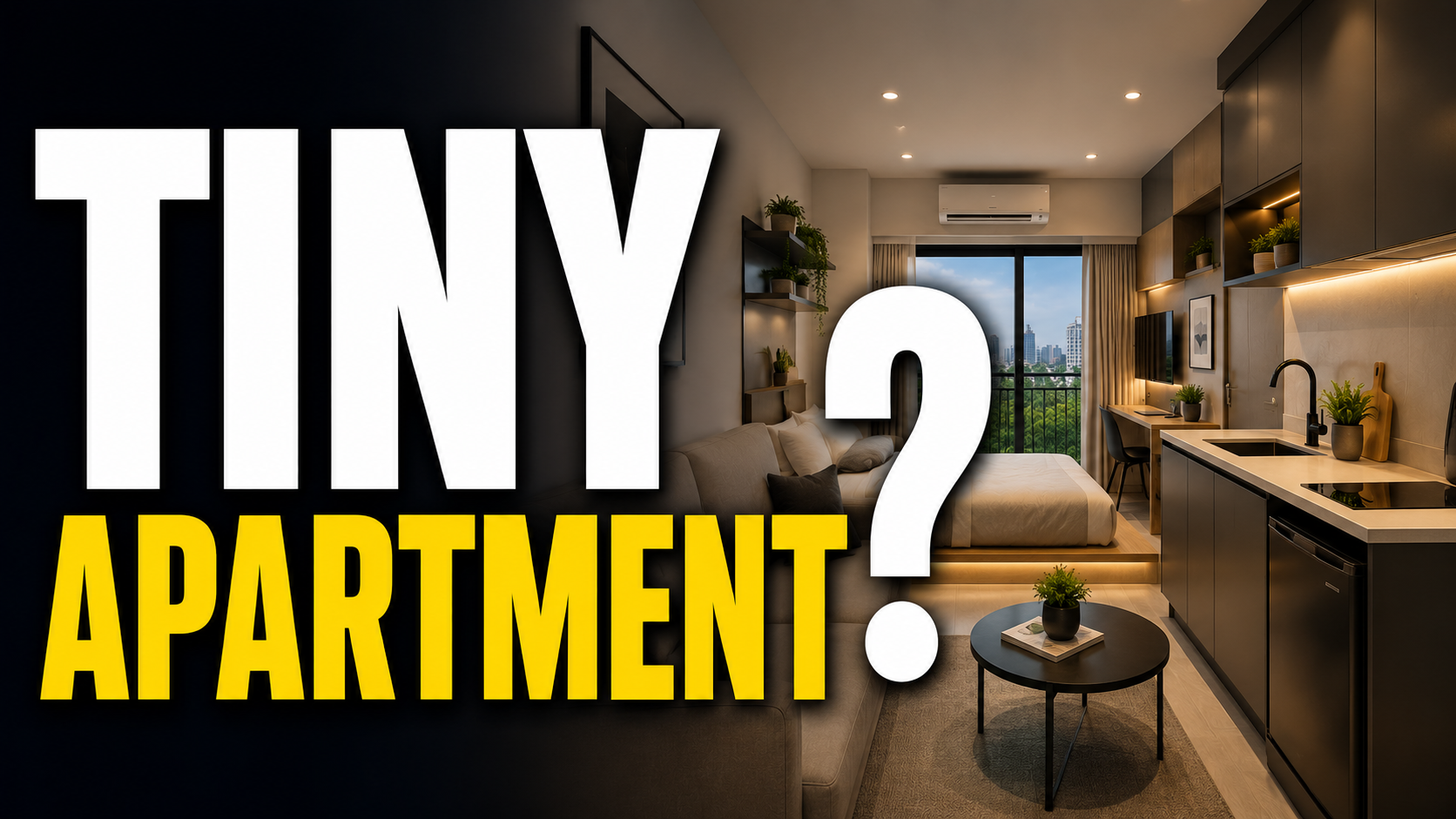
What if the future of Ghanaian housing is not a bigger house, but a smaller home that makes more financial sense?
Imagine choosing between a spacious property that stretches your budget and a compact apartment that gives you privacy, a manageable monthly cost, and access to the places you visit every day.
Which one actually offers a better life?
That question is at the heart of the debate about tiny apartments in Ghana. The argument is not that everyone should live in a single room. It is that housing should respond to people’s incomes, household sizes, and everyday needs—not just the number of bedrooms that looks impressive in an advertisement.
Ghana’s census evidence provides important context. In 2021, 56.7% of the population lived in urban areas, while the national average household size was 3.6 people. These figures help explain why a wider range of smaller homes deserves attention, although they do not prove that tiny apartments will dominate the housing market.
For renters, developers, and property investors, the opportunity is worth examining. So are the risks.
Watch: Why Tiny Apartments Are Becoming Ghana’s Future
Watch the Kumadoh Perspective episode below.
What Do We Mean by Tiny Apartments?
In this article, “tiny apartments” refers to compact, self-contained homes, including studios and smaller one-bedroom apartments. It is a descriptive term, not a claim about an official Ghanaian minimum or maximum floor area.
The distinction between compact and cramped matters.
A compact apartment should provide usable space for sleeping, cooking, bathing, storage, and everyday living. A cramped apartment simply removes space without considering how someone will live there.
The goal should not be to build the smallest possible home.
It should be to create a home that uses its available space well—and offers genuine value.
Ghana’s Urban Housing Needs Create a Case for Smaller Homes
Ghana’s urban population share increased from 50.9% in 2010 to 56.7% in 2021, according to UN-Habitat’s Ghana country brief. That change provides a clear reason to think carefully about how housing is delivered in urban areas.
One possible response is to accommodate more households within well-planned apartment developments rather than relying exclusively on homes that require a separate plot for every household.
However, density alone is not the answer.
A building with more apartments also needs appropriate water supply, sanitation, access, waste collection, and shared-space management. Adding units without planning for daily life can create a different housing problem instead of solving the original one.
The useful question is therefore not simply, “How many apartments can fit on this land?”
It is, “How many comfortable, functional homes can this site support?”
Smaller Households Need More Housing Choices
The Ghana Statistical Service’s final 2021 census report recorded a decline in average household size from 4.5 people in 2010 to 3.6 in 2021. In urban areas, the average fell from 4.1 to 3.3 people.
This does not mean the average household should live in a studio. It suggests that housing supply should offer more variety instead of treating the large family house as the only desirable option.
Consider a person starting their first job. Their immediate priority might be a secure, private place to live—not three bedrooms and a large compound.
A couple without children might prefer a well-designed one-bedroom apartment while building their savings. Someone working temporarily in another city might need a practical base rather than a permanent family home.
These are different housing needs. They should not all be forced into the same property type.
For developers, the implication is straightforward: design for the intended resident before deciding how many bedrooms to advertise.
Affordability Is About More Than the Purchase Price
The Centre for Affordable Housing Finance in Africa’s 2024 Ghana profile identified land and building-material costs, limited access to housing finance, and affordability pressures as important challenges in the housing market. It also highlighted the mismatch between luxury accommodation and the shortage of housing accessible to lower-income households.
That context helps explain the appeal of smaller apartments.
All else being equal, reducing floor area can reduce some of the construction work and finishing required for an individual home. But a smaller apartment does not automatically become affordable. Its price can still reflect expensive land, premium finishes, financing costs, and the developer’s target market.
There is also a difference between a lower total price and better value.
Consider this hypothetical comparison—not current Ghanaian market pricing:
| Property | Purchase price | Internal floor area | Price per square metre |
|---|---|---|---|
| Apartment A | GH₵600,000 | 30 m² | GH₵20,000 |
| Apartment B | GH₵900,000 | 60 m² | GH₵15,000 |
Apartment A requires less money upfront, but costs more for each square metre.
Neither option is automatically better. The decision depends on the buyer’s budget, the usable layout, the location, and the ongoing costs.
When comparing apartments, look beyond the headline price. Include service charges, utility arrangements, furnishing, maintenance, and any financing payments in the calculation.
A smaller home only improves affordability when the total cost works for the person living there.
Rental Housing Makes Compact Apartments Worth Examining
The 2021 census found that 46.0% of urban households occupied rented dwelling units, compared with 17.1% in rural areas. Greater Accra recorded a rental share of 47.6%. These figures show the importance of rental housing, but they do not establish demand for any particular apartment size.
For anyone considering build-to-rent in Ghana, that distinction matters.
A substantial rental market is not a guarantee that every studio development will succeed. The relevant question is whether the proposed apartment matches an identifiable tenant’s budget and needs.
Before designing a building, investigate who would rent there, what comparable properties actually achieve, and which features tenants consider essential.
A student-focused apartment, a long-term home for a working professional, and a furnished short-stay unit should not automatically share the same design or business model.
Build for a defined resident—not an imaginary tenant who can afford any rent.
Location Should Be Judged by Everyday Use
Consider two hypothetical homes.
The first offers more space but requires a long, expensive journey to work. The second is smaller but makes the resident’s routine easier.
The larger home may still be the better choice, especially for a family. But the comparison should include more than bedroom count.
For your own decision, calculate:
Monthly housing cost + utilities + service charges + transport cost.
Then consider the time involved in travelling, the practicality of the route, and whether the apartment supports the way you live.
A compact apartment should offer a meaningful benefit in exchange for the space you give up. That benefit might be a lower total cost, a more convenient location, or less space to maintain.
Without such a benefit, “small” is not a selling point.
Can Tiny Apartments Be a Good Property Investment?
They can be worth evaluating, but apartment size is not an investment strategy on its own.
Start with the complete acquisition or development cost. Add furnishing and other setup expenses where relevant. Then estimate rental income using evidence from comparable properties—not only a developer’s projected returns.
From that income, allow for vacancies, repairs, management, insurance, and owner-paid building charges. Assess financing and taxes separately.
A hypothetical example illustrates why this matters. Suppose an apartment costs GH₵600,000 and produces GH₵48,000 in annual rent. Its gross rental yield is 8%.
If vacancies and operating expenses reduce annual income to GH₵30,000, the return before financing and tax falls to 5% of that purchase price. Additional acquisition and furnishing costs would reduce the percentage further.
Those are illustrative figures, not a forecast for Ghana’s apartment market.
The lesson is simple: a lower purchase price does not guarantee a strong return.
For diaspora investors evaluating property remotely, request the floor plan, written service-charge information, and an independent inspection. Have a qualified local professional review the transaction and ownership documents before committing funds.
How Small Is Too Small?
Instead of judging a compact apartment only by its stated floor area, walk through an ordinary day.
Can you prepare a meal without blocking the main walkway? Is there space for clothes, cleaning supplies, and luggage? Can you open cupboards and doors when furniture is in place? Is there somewhere practical to work or eat?
Check the apartment’s natural light, ventilation, privacy, noise, bathroom arrangement, and safe access. Ask an appropriately qualified professional to assess relevant building requirements rather than relying on marketing photographs.
Also consider how the home would work a few years from now.
A studio that suits one person may not meet the needs of a growing family. Someone working from home may need separation between sleeping and working areas. A resident with mobility needs may require a different layout altogether.
Good compact design should remove wasted space—not basic comfort.
Tiny Apartments Cannot Solve Ghana’s Housing Problem Alone
The same 2021 housing census recorded 12.7% of the residences counted as vacant dwelling units. That is not a measure of vacancy in Accra’s studio market, and it does not explain why each property was empty. It does, however, caution against assuming that building more units automatically matches people with suitable homes.
My view is that compact apartments should form part of a broader housing mix, not become a universal prescription.
Ghana needs options for different household sizes, incomes, locations, and life stages. Making every apartment smaller would not necessarily address financing barriers, inconvenient locations, or unaffordable recurring charges.
The test should be whether a development improves access to decent housing—not whether it fits more doors into a building.
The Future Should Be Smaller Where It Makes Sense—and Better Everywhere
The strongest case for tiny apartments in Ghana is not that people should lower their expectations.
It is that expectations should focus on what makes a home useful: a workable price, a functional layout, appropriate services, and a location that supports daily life.
For renters, that means comparing the full cost of living rather than chasing an impressive address.
For developers, it means designing around actual residents and realistic budgets.
For investors, it means testing demand and calculating income after expenses.
A well-planned small apartment can be a sensible choice. An overpriced, poorly designed small apartment is simply a smaller version of the same housing problem.
The future should not be about living with less dignity. It should be about getting more value from the space—and money—available.
What would you choose: a larger home farther from your daily activities, or a smaller apartment that makes everyday life easier?
Watch the full Kumadoh Perspective episode above and share your thoughts.
Frequently Asked Questions
Are tiny apartments in Ghana always affordable?
No. Compare the total purchase price or rent, usable floor area, service charges, utilities, and transport costs. A small apartment can have a lower headline price without offering better overall value.
Is a studio apartment suitable for a family?
Suitability depends on the household’s size and needs. Assess privacy, sleeping arrangements, storage, and everyday activities rather than assuming a studio can comfortably accommodate everyone.
Should I buy a small apartment for rental income?
Evaluate the individual property rather than buying because of its size. Use realistic rental evidence, allow for vacancies and expenses, and obtain independent advice on the transaction and financial commitments.
Will tiny apartments replace larger homes in Ghana?
That is not the argument here. Compact apartments could serve some housing needs, while larger apartments and family homes remain necessary for others.