
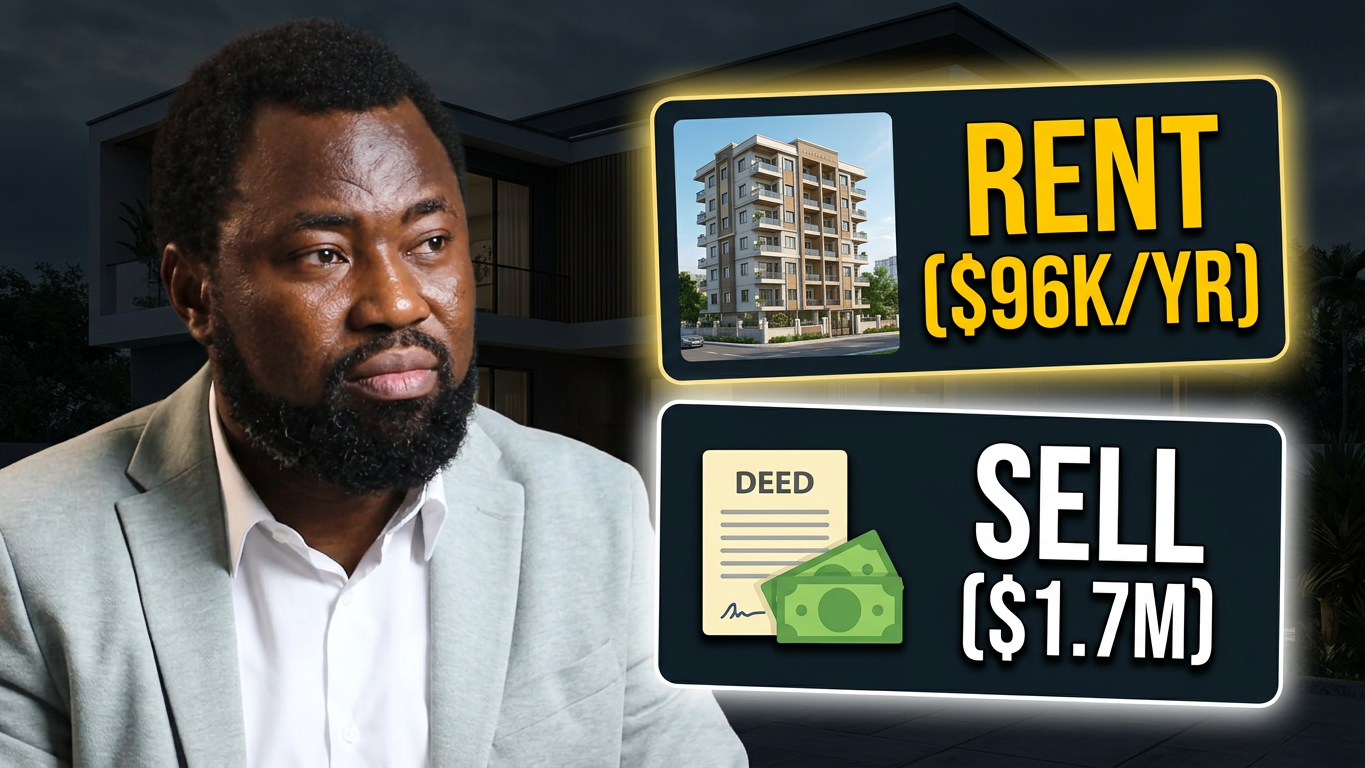
You have finished building your house. Perhaps you have inherited a property, bought an apartment or completed a small residential development.
Now comes a decision that deserves just as much attention as the construction itself: should you rent or sell your property in Ghana?
One person tells you never to sell property because ownership is the foundation of generational wealth. Another says you should sell, take your profit and move on to the next investment.
Neither answer is enough.
Renting can provide income while you retain the property. Selling can release capital for other priorities. But rental income is not guaranteed, property values can fall, and both ownership and selling involve costs.
The better question is not simply, “Which option brings in more money?”
It is: “Which option puts my capital to better use, given my goals, costs and risks?”
That is where a real wealth strategy begins.
Renting vs Selling Property in Ghana: What Are You Trying to Achieve?
Before comparing rental income with a potential selling price, decide what you need the property to do.
Are you looking for income to support your household? Do you need capital to complete another project? Are you preparing for retirement? Or are you holding the property because you may live in it later?
These are different objectives, and they can lead to different decisions.
For this comparison, renting means letting your property to tenants while keeping ownership. Selling means transferring ownership in exchange for an agreed price.
Your decision should begin with your priorities—not with a blanket rule that every property should be kept forever or sold as soon as a buyer appears.
When Renting Out Your Property May Make Sense
Renting deserves serious consideration when you want ongoing income, do not urgently need to recover your capital, and have a workable plan for managing the property.
However, assess it as an operating investment rather than a finished building that automatically produces profit.
Look beyond the advertised monthly rent
A property advertised at GH₵7,500 per month does not automatically put GH₵90,000 in your pocket every year.
Vacancy periods, repairs, insurance and management fees can reduce the amount you retain. Loan payments can create further pressure, especially when the property is empty.
Instead of asking only what rent you could charge, ask what you could realistically collect—and what would remain after your obligations.
Include rental income tax in your planning
Rental income in Ghana is subject to tax. The Ghana Revenue Authority publishes rent-tax guidance that distinguishes residential from commercial and non-residential premises. Confirm the treatment that applies to your ownership structure and rental activity before calculating your spendable income.
The important distinction is simple: rent collected is not the same as money available to spend.
How to Calculate Your Property’s Rental Return
Consider the following hypothetical example. These figures illustrate the calculation; they are not current Ghanaian market averages.
Assume your property has an estimated current market value of GH₵1,500,000 and could rent for GH₵7,500 per month.
| Item | Illustrative amount |
|---|---|
| Estimated current property value | GH₵1,500,000 |
| Potential annual rent at full occupancy | GH₵90,000 |
| Allowance for one vacant month | −GH₵7,500 |
| Expected rent collected | GH₵82,500 |
| Annual operating expenses | −GH₵22,500 |
| Operating income before tax, financing and major capital works | GH₵60,000 |
The gross rental yield would be:
GH₵90,000 ÷ GH₵1,500,000 × 100 = 6%
After the assumed vacancy and operating expenses, the operating yield would be:
GH₵60,000 ÷ GH₵1,500,000 × 100 = 4%
That 4% is still not your final spendable return. Rental income tax, any loan payments and money reserved for major replacements must also be considered.
For example, setting aside another GH₵10,000 for future major works would leave GH₵50,000 before tax and financing.
The lesson is not that a 4% operating yield is automatically good or bad. It is that the headline rental figure tells only part of the story.
For an existing property, also look beyond its original construction cost. A keep-versus-sell decision should consider its achievable value today and the equity you could actually release.
When Selling Your Property May Make Sense
Selling deserves consideration when releasing capital would serve a clear purpose.
You might need to reduce debt, finish another development, simplify your finances or move money into an opportunity that better matches your goals.
But selling is not automatically a successful investment outcome. The important number is what remains after the transaction—not the headline selling price.
Calculate your net sale proceeds
A practical starting point is:
Net sale proceeds = sale price − selling costs − applicable taxes − outstanding property debt
Selling costs may include agreed agent fees, legal expenses, marketing and work you choose to complete before the sale.
Ghana’s tax treatment also needs attention. The GRA identifies gains from real-estate disposals as potentially taxable and distinguishes capital assets from trading inventory. An individual selling an investment property and a developer selling stock should not assume identical treatment.
Have the relevant tax position checked before treating the expected proceeds as available investment capital.
Decide what the money will do next
Selling a property converts an asset into cash. Whether that strengthens your financial position depends partly on what happens afterwards.
Consider two hypothetical owners.
The first sells an underperforming property, clears expensive debt and uses the balance to complete a carefully budgeted project.
The second sells a productive rental property without a plan and gradually spends the proceeds.
Both have sold property, but they have made very different wealth decisions.
Before accepting an offer, write down the intended use of the proceeds, the expected costs and the risks. “I will find something better later” is not yet an investment plan.
Build to Rent vs Build to Sell in Ghana
For someone planning a development, the rent-or-sell decision should influence the project before construction begins.
Build to rent: plan around sustainable income
Under a build-to-rent strategy, you retain the completed units and let them to tenants.
Test the design and budget against the rent your intended tenants could realistically pay. Consider whether the layout, finishes and maintenance requirements make sense for a property you expect to operate for years.
A useful question is:
“Will this feature help attract and retain tenants, or will it mainly increase my construction and maintenance costs?”
Build to sell: plan around a realistic exit
Under a build-to-sell strategy, the project is intended for sale rather than long-term ownership.
Your feasibility calculation should include more than land and construction. Allow for professional services, finance, marketing, transaction costs and the possibility of a longer selling period.
Also, compare returns over equivalent time periods. A projected development profit earned over three years should not be compared directly with one year’s rental yield.
These are different strategies. Neither deserves to be called “better” without examining the actual project.
Compare Both Options Over the Same Time Period
One misleading comparison is to place one year’s rental income beside the full selling price.
The sale figure will look much larger—but the rental option leaves you owning the property.
A more useful exercise is to compare both choices over the same period, such as five years.
For the keep-and-rent option, estimate the rental cash you could retain during that period and the property’s possible net sale value at the end, after selling costs, tax and any remaining debt.
For the sell-and-reinvest option, estimate the cash you would release now and what the next use of that money could produce over the same period.
Use conservative assumptions for both. Do not give the rental property guaranteed appreciation while treating the alternative investment cautiously—or do the reverse.
Run a weaker-outcome scenario as well. What happens with lower rent, longer vacancies, an unexpected repair or a delayed sale?
The purpose is not to predict the future perfectly. It is to see which decision remains workable when the outcome is less favourable than expected.
Could You Sell Some Units and Rent Out the Rest?
For a development with multiple units, a hybrid strategy may be worth evaluating.
Imagine a project with four homes. Instead of selling all four or keeping all four, you could examine whether selling two would release useful capital while the remaining two provide rental income.
That is a scenario to test, not a formula to follow.
The sale proceeds may not recover as much capital as expected. The retained units may carry ongoing shared costs. Your financing arrangements may also affect what you can sell.
Before proceeding, ask a qualified property lawyer to check whether separate sales are possible and what title arrangements, approvals, lender consents and shared-property agreements would be needed.
The principle is flexibility: the same project does not necessarily need one identical strategy for every unit.
What Ghanaian Diaspora Property Owners Should Consider
For an owner living outside Ghana, management deserves particular attention.
Distance can make it harder to supervise repairs and oversee property managers. Exchange-rate movements can also change the value of rental income when converted into the currency you use abroad.
Before choosing to rent, establish a reporting system. Specify how rent will be collected, how expenses will be approved and what evidence will accompany maintenance requests.
Ask for an actual management-fee quotation and include it in your calculations. Do not base the investment case on unpaid assistance that may not remain available.
Before choosing to sell, establish an equally clear process for reviewing offers, authorising the transaction and accounting for the proceeds.
In either case, the financial plan should work with the oversight you can realistically provide.
The Decision Test: Keep It, Sell It or Reposition It?
Try answering three questions in writing.
Does keeping the property meet a clear objective?
Identify the income, future use or long-term ownership benefit you expect. Then calculate what it will cost to pursue that objective.
Would selling leave you in a stronger position?
Estimate the net proceeds and explain exactly how you would use them. Compare the risks of that plan with the risks of continued ownership.
Are you judging the property by its performance or your attachment to it?
A family home may have value that cannot be expressed as a rental yield. That is legitimate. But distinguish a personal decision from a claim that the property is your best-performing investment.
You do not have to sell a meaningful property simply because another option might earn more. Equally, you do not have to keep an unsuitable investment merely to prove that you own real estate.
Frequently Asked Questions
Is it better to rent or sell a house in Ghana?
Neither option is universally better. Compare realistic rental cash flow, net sale proceeds, your need for capital and your plans for the property or money. The strongest choice is the one that fits your circumstances under reasonable assumptions.
How do I know whether my rental property is profitable?
Start with rent actually collected, not just rent advertised. Deduct operating expenses and applicable taxes, then assess loan payments and major-repair requirements separately. Keep a clear distinction between operating income, spendable cash flow and changes in property value.
Should I sell my property to build another house?
Evaluate the new project before selling. Prepare a full budget, confirm how you would cover overruns and identify whether the completed property would be rented, sold or used personally. A larger building is not automatically a better financial outcome.
Can I rent out a property now and sell it later?
That can be an option, but plan the later sale around the tenancy rather than assuming immediate vacant possession. Have a qualified lawyer review the lease and your obligations before committing to a selling timetable.
Final Thoughts: Wealth Is About What Your Property Does for You
The decision to rent or sell your property in Ghana should not be reduced to “landlords always win” or “selling is the fastest way to get rich.”
Start with the numbers. Be honest about your goals. Consider the work involved. And make a plan for what happens after the decision.
Rent when the income and ownership benefits justify the costs and risks. Sell when the capital released has a clearer purpose. Consider a mixed approach when the project and legal structure allow it.
At Kumadoh Perspective, the question is not simply whether you own property. It is whether your property decisions are helping you build the life and financial position you actually want.
Would you keep a property for rental income or sell it to fund your next investment? Share your reasoning in the comments, and subscribe to Kumadoh Perspective for more discussions about real estate, business and investment in Ghana.
This article provides general educational information, not personalised financial, tax or legal advice. All numerical examples are hypothetical.