
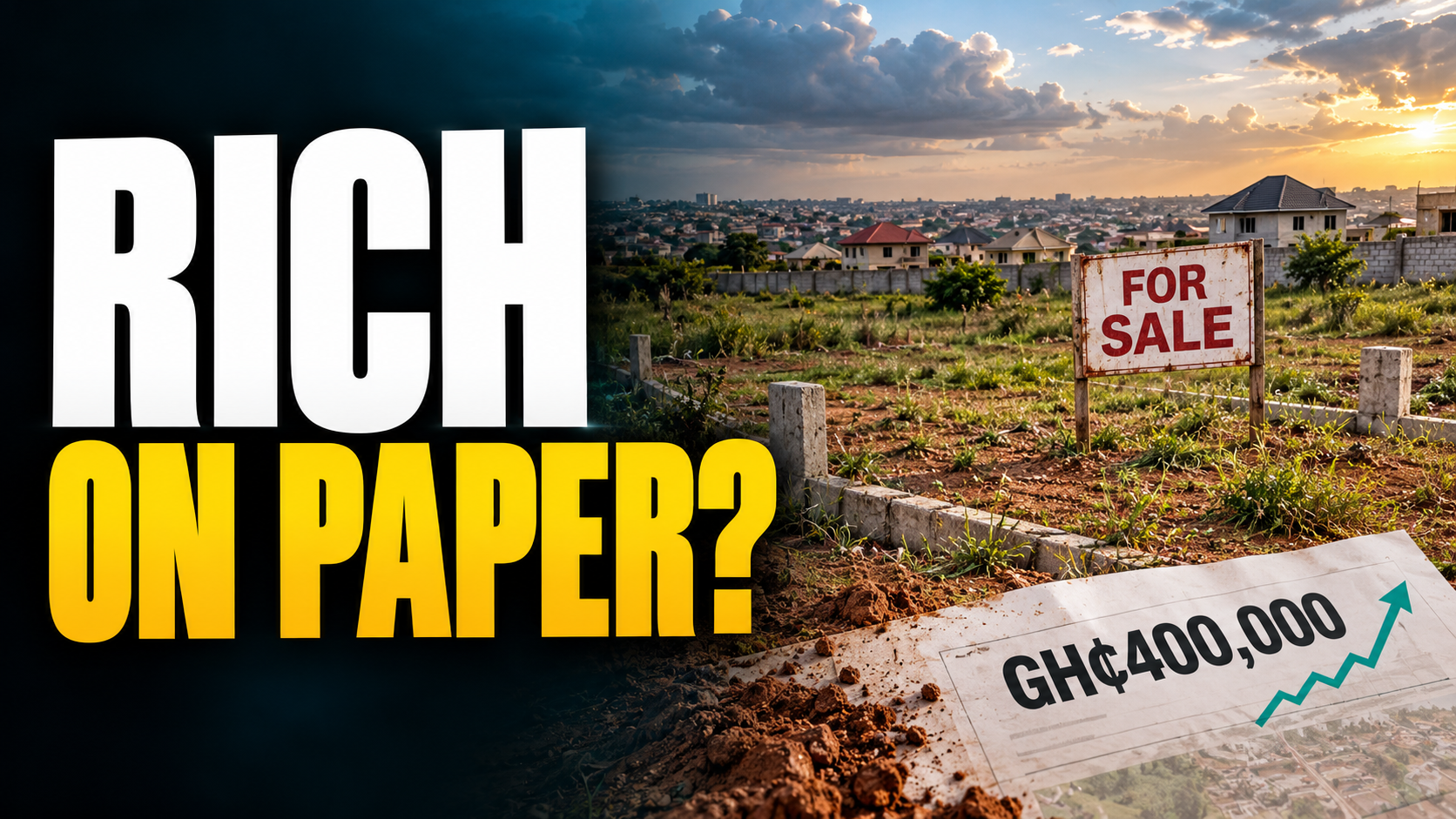
You bought a plot of land in Ghana for GH₵200,000. A few years later, an agent tells you it could now sell for GH₵400,000. Nearby advertisements seem to support the claim, and suddenly, you feel considerably wealthier.
Then you decide to sell.
The calls come in. A few prospective buyers visit. Some ask for documents, others negotiate, and several promise to get back to you. Months pass without a completed transaction.
Has your land doubled in value? Perhaps. But how much of that value can you actually access?
For anyone considering land investment in Ghana, this distinction matters. An asking price, a market valuation and the money received from a completed sale tell different stories.
An asking price is not proof of a sale
One of the easiest mistakes in property investment is treating advertised prices as evidence of what buyers are paying.
If your neighbour lists a plot for GH₵400,000, that tells you what the owner hopes to receive. It does not confirm that a buyer has agreed to pay it.
Imagine three landowners in the same neighbourhood. One advertises at GH₵400,000. Another sees the listing and asks GH₵450,000 because their plot has better road access. A third decides their own property must be worth GH₵500,000.
The advertisements create an impression of rising prices. Yet none of the plots may have sold.
Asking prices provide useful information about sellers’ expectations. Completed transactions offer stronger evidence of what buyers have accepted under particular conditions.
Before concluding that your land has doubled in value, ask what supports that estimate.
Watch full video here
Estimated wealth and accessible money
An unsold property can still have substantial value. You do not need to sell land for its appreciation to be meaningful.
However, an estimate of value does not guarantee an immediate buyer.
A professional valuation can help establish a likely market value using relevant evidence and stated assumptions. It cannot promise that someone will arrive tomorrow with the full amount.
This is where liquidity becomes important: how easily an asset can be converted into cash without a substantial reduction in price.
You could own valuable land and still struggle to meet an urgent financial obligation. The property represents wealth, but accessing that wealth may take time.
A business owner might hold several plots while needing money to pay suppliers. A family might own land but need cash to complete a home. In both cases, the asset and the immediate financial need operate on different timelines.
Your actual return may be smaller than the headline gain
Consider this illustrative example:
| Item | Amount |
|---|---|
| Original purchase price | GH₵200,000 |
| Additional acquisition and holding expenses | GH₵20,000 |
| Total amount spent | GH₵220,000 |
| Advertised selling price | GH₵400,000 |
| Eventual completed sale price | GH₵340,000 |
| Illustrative selling expenses | GH₵15,000 |
| Net sale proceeds | GH₵325,000 |
| Nominal gain against total spending | GH₵105,000 |
The owner has made a gain. But the result is different from saying, “I bought at GH₵200,000 and doubled my money.”
The advertised price was never the amount received. Purchase-related expenses, holding expenses and selling expenses also affected the outcome.
The holding period matters too. A gain earned over two years has a different investment meaning from the same gain earned over fifteen years. Inflation also affects what the eventual proceeds can buy.
These figures are fictional and do not represent current Ghanaian land prices or standard transaction charges. They illustrate why returns should be calculated from the full investment rather than the advertisement.
Who can afford to buy your land?
When discussing land appreciation, owners sometimes overlook the next buyer.
If you bought a plot at an accessible price and now want twice as much, has the pool of potential buyers grown—or become smaller?
A successful sale requires someone who wants your particular property, can afford it and is ready to proceed on acceptable terms.
A person who admires the location but cannot raise the money is not yet a buyer. Someone with the money who prefers a different neighbourhood is not your buyer either.
Prospective buyers will also compare your land with alternatives. They may consider road access, nearby development, utilities, documentation, drainage and the total cost of making the plot useful.
You may see an investment you have patiently held for ten years. They may see one of several available plots.
Understanding their choices can help you assess whether your asking price is competitive.
A nearby sale may not be a fair comparison
A reported sale in the same area can be useful evidence, but the details matter.
Were the plots similar in size? Did they have comparable access? Were the ownership interests and documentation similar? Was one closer to established housing or services?
Payment terms can also affect the comparison. An advertised total payable over an extended period is not necessarily equivalent to an immediate cash transaction.
Even the reported figure deserves scrutiny. Was it the asking price, an agreed price or the amount paid at completion?
“Someone sold land nearby” should begin the investigation, rather than end it.
Buyer confidence can determine whether a sale proceeds
Price is only one reason a land sale can stall.
A prospective buyer may like the location and accept the asking price but remain uncomfortable with unanswered questions about the property.
Where are the boundaries? Who has authority to sell? Can the documents and ownership claims be independently checked? Is there a dispute? What access comes with the plot?
An owner’s confidence does not replace evidence a buyer can verify.
If important questions remain unresolved, negotiations may slow down or collapse. Reducing the price may not solve the underlying uncertainty.
Organised records, clear information and appropriate professional assistance can help buyers investigate the property. They also help an owner identify issues before those issues disrupt a transaction.
Your financial need does not set the market price
Selling land can become emotional, particularly when the proceeds are intended for an important goal.
You may need GH₵500,000 to complete a house or expand a business. That explains why you want the money. It does not establish what another person will pay for your plot.
The buyer will assess their own budget, alternatives and concerns.
Pride can complicate the decision further. If you have repeatedly told family and friends that your land is worth a particular amount, accepting a lower offer may feel like admitting failure.
But a negotiation should be assessed against evidence and your circumstances.
One low offer does not prove that your asking price is wrong. Several credible offers following reasonable market exposure, however, deserve consideration. So does a long period without serious interest.
The useful question is why buyers are resisting.
Waiting can be reasonable—but it needs a plan
A slow sale does not automatically make land a poor investment.
An owner with a long investment horizon and sufficient cash elsewhere may be comfortable waiting for a suitable buyer. Another owner who needs the proceeds urgently faces a different situation.
The same property can therefore suit one person’s finances and create difficulties for another.
Waiting also carries uncertainty. Future development may improve demand, but higher prices and a quick sale are not guaranteed.
A practical holding plan considers how long you can wait, what expenses may continue and how you would manage if the sale took longer than expected.
Questions to ask before counting the profit
Whether you already own land or are considering a purchase, these questions can make your expectations more realistic:
- What evidence supports the estimated value?
- What have genuinely comparable properties sold for?
- Who is the likely buyer, and what alternatives do they have?
- What documentation or property issues could delay a sale?
- What would remain after relevant expenses and obligations?
- How long could you comfortably wait for completion?
These questions shift attention from an attractive headline price to the practical process of realising a return.
Before you count the profit, ask who is ready to pay
Land ownership can be an achievement and a valuable part of long-term wealth building. Rising values can create real opportunities.
But an advertised increase does not automatically provide spendable money.
The next time someone says, “My land has doubled in value,” ask what supports the claim: neighbouring advertisements, a professional valuation, comparable completed sales or a credible offer?
Each answer provides a different level of evidence.
Understanding that difference can help you make clearer decisions about buying, holding and selling land in Ghana—and avoid relying on money that may take much longer to access than you expect.
Have you tried selling land in Ghana? Share what affected your experience: the price, location, documentation, payment terms or the difficulty of finding a serious buyer.
For more conversations about real estate, business and investment in Ghana, follow Kumadoh Perspective with Uriah Kumadoh.