
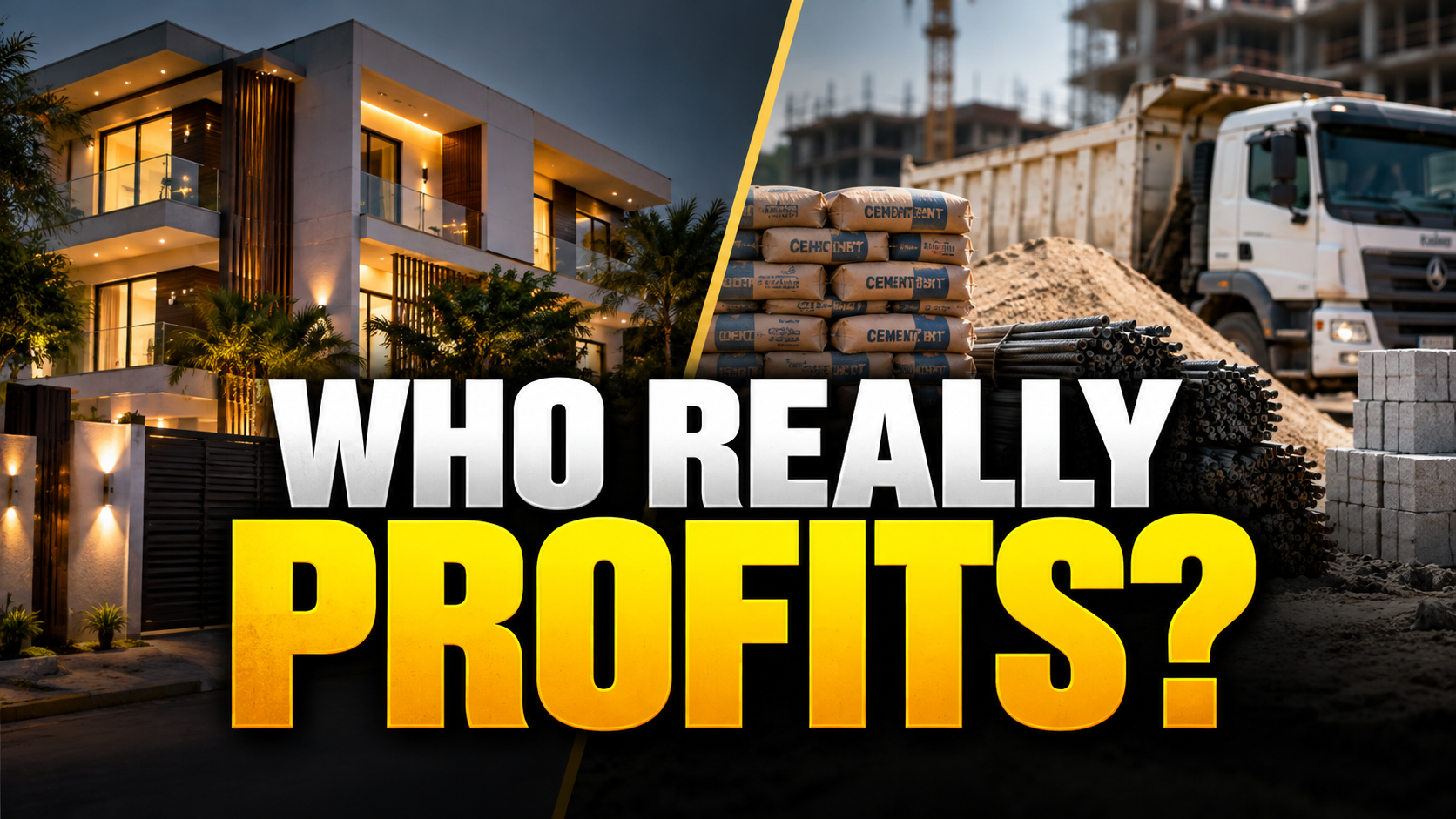
Ghana’s real estate industry is creating wealth beyond property ownership. From building materials suppliers to logistics companies, discover the businesses making money from Ghana’s construction and property market.
In Ghana, owning property is considered one of the greatest symbols of financial success. Whether it is a luxury apartment in Cantonments, a family house in East Legon, or land in a developing community, property ownership remains a major financial aspiration.
But what if some of the most interesting investment opportunities in Ghana’s real estate industry have very little to do with owning property?
Before a homeowner completes a building, construction material suppliers, transport operators, architects, contractors, engineers, and other service providers may have already earned money from the project.
Meanwhile, the property owner might still be waiting for rental income, capital appreciation, or a buyer willing to pay the desired price.
This raises an important question: Are property owners really the biggest winners in Ghana’s real estate market, or are the businesses serving them capturing opportunities that many investors overlook?
Ghana’s Obsession With Property Ownership
For generations, owning a house has represented financial security, independence, and social achievement in Ghana.
Many Ghanaians living abroad spend years saving to purchase land or build homes in Accra, Kumasi, Tema, and other developing communities.
While owning property can create long-term wealth, it is important to distinguish between owning an expensive asset and owning a profitable investment.
A residential property may appreciate over time, but appreciation is never guaranteed. Rental properties can generate income, but maintenance expenses, vacancies, taxes, and management costs can significantly reduce returns.
This is why investors should consider the broader business opportunities connected to Ghana’s real estate industry rather than focusing exclusively on land and buildings.
Watch Full Video Here.
1. Building Materials Suppliers: Making Money Before the House Is Finished
Every construction project requires materials.
Cement, sand, stones, iron rods, roofing sheets, electrical cables, plumbing materials, tiles, doors, and windows are essential to residential and commercial development.
Each purchase creates revenue for another business.
A developer constructing twenty houses may need repeated deliveries of construction materials. Individual homeowners and renovation contractors also contribute to demand.
A building materials supplier can therefore serve multiple projects without financing the ownership of those buildings.
For example, a cement distributor may supply several construction sites, while a roofing materials company may serve homeowners and commercial developers across different locations.
However, revenue does not automatically translate into profit. Inventory costs, transportation expenses, competition, and outstanding customer payments can affect profitability.
The opportunity lies in establishing an efficient business capable of serving multiple construction projects while managing costs and maintaining healthy profit margins.
2. Construction Contractors and Professionals: Earning From Development
Construction companies, architects, engineers, electricians, plumbers, and project managers form another important part of Ghana’s real estate economy.
Their businesses generate income by providing services rather than necessarily owning completed properties.
An architectural firm can design projects for multiple clients, while a construction company can manage residential and commercial developments.
Successful operators may expand their businesses through repeat customers, professional expertise, and strong project management.
However, construction projects carry financial risks, including delays, rising material costs, labor challenges, and contract disputes.
The lesson for investors is that the property industry offers opportunities beyond buying land, but those opportunities require proper financial planning and operational discipline.
3. Logistics and Haulage: The Business Behind Ghana’s Construction Industry
One of the most overlooked opportunities in Ghana’s real estate industry is logistics.
Every construction project depends on the movement of goods.
Sand must be transported from suppliers. Cement must reach building sites. Iron rods, blocks, tiles, roofing materials, equipment, and finishing products must be delivered.
Without transportation, construction activities become difficult and expensive to coordinate.
Consider developing communities such as East Legon Hills, Oyarifa, Ayi Mensah, Oyibi, and other growing residential areas.
As construction projects expand, so does the need for cargo transportation, truck hire, materials distribution, and equipment movement.
A logistics operator can generate revenue from multiple construction projects without purchasing the completed properties.
However, the economics of transportation must be properly managed.
Fuel, vehicle maintenance, insurance, driver wages, repairs, and downtime all affect profitability.
This is why technology-driven logistics platforms are becoming an interesting part of the broader construction and business ecosystem.
CargoMov: Connecting Construction Projects With Logistics Services in Ghana
Sponsored feature — CargoMov
For property developers, contractors, building materials suppliers, and individuals constructing homes in Ghana, coordinating transportation can be one of the challenges of a construction project.
Finding an appropriate vehicle, comparing delivery costs, arranging pickups, and coordinating deliveries across different locations requires time and planning.
CargoMov is a Ghanaian digital logistics marketplace developed to connect customers and businesses with transport providers for cargo delivery, truck hire, haulage, and construction-related transportation.
The platform is powered by Relocation Masters Ltd and is designed to simplify how people arrange the movement of goods across Ghana.
Rather than relying exclusively on individual transport contacts, customers can submit cargo requests, provide pickup and delivery information, and compare offers from eligible drivers.
Construction Materials and Site Deliveries
Construction projects frequently require transportation of cement, sand, stones, blocks, iron rods, and other building materials.
Through CargoMov’s construction supplies service, contractors, homeowners, and developers can explore options for sourcing materials together with delivery or arranging transportation for materials already purchased.
This can be particularly useful for people managing construction projects in Ghana while living abroad.
Truck Hire and Haulage Services
Different construction activities require different vehicles.
Smaller loads may be suitable for pickups or light-duty trucks, while larger materials and equipment may require tipper trucks, flatbeds, or other specialized vehicles.
CargoMov provides a platform for exploring truck rental and haulage services in Ghana, allowing customers to request appropriate vehicles for their transportation needs.
Business and Contractor Logistics
Construction companies and building materials suppliers often require recurring deliveries to different project locations.
CargoMov offers business and corporate logistics accounts for organizations looking to manage delivery requests, business records, invoices, and ongoing transportation requirements.
Opportunities for Drivers and Truck Owners
The construction logistics industry also presents opportunities for commercial vehicle owners and drivers.
Individuals operating suitable transport vehicles can explore becoming a CargoMov driver, where registration, vehicle verification, and eligibility requirements apply before access to available jobs.
This provides another example of how entrepreneurs can participate in real estate-related economic activity without owning the properties being constructed.
Explore CargoMov
- Cargo delivery: Post a Cargo Job
- Construction projects: Request Construction Materials and Delivery
- Transport services: Explore Truck Rental in Ghana
- Commercial operations: CargoMov Business Accounts
- Truck owners and drivers: Register as a Driver
- Booking assistance: Become a CargoMov Agent
- General enquiries: Contact CargoMov
CargoMov — Move Anything, Anytime.
Visit www.cargomov.app to explore the available services.
The emergence of platforms like CargoMov highlights a broader investment lesson: The people enabling real estate development can participate in the industry’s growth without necessarily owning the buildings being developed.
4. Property Management: Generating Income From Buildings You Don’t Own
Property management is another business model that can generate revenue from real estate without requiring ownership of every managed property.
Imagine an investor who owns ten apartments in Accra but lives in London, Amsterdam, or New York.
Those apartments require tenants, maintenance, inspections, rent collection, and administrative oversight.
A professional property management company can provide these services in exchange for agreed fees.
Instead of purchasing ten apartments, an entrepreneur could establish a business managing properties for ten different owners.
As the company attracts more clients, it may increase recurring service income without purchasing additional buildings.
Of course, property management comes with challenges, including tenant disputes, maintenance problems, customer expectations, and staffing costs.
Nevertheless, it demonstrates another way to participate in Ghana’s real estate industry.
5. Real Estate Technology: Building Businesses Around Property Ownership
Technology is introducing new business models into traditional industries.
Property listing platforms, rental management software, construction procurement systems, logistics marketplaces, and digital property administration services can help homeowners, developers, investors, and businesses operate more efficiently.
These companies do not necessarily need to own the properties they serve.
Their value comes from technology, customer relationships, operational efficiency, and solving real market problems.
The opportunity may be scalable, but technology businesses also face development costs, competition, customer acquisition challenges, and operational risks.
For entrepreneurs interested in Ghana’s real estate market, these businesses represent alternatives worth examining alongside traditional property investment.
6. What If You Invested GH₵1 Million Differently?
Imagine two investors, each with GH₵1 million.
The first investor purchases a rental property, while the second invests in a construction materials distribution business.
For illustration, assume the following hypothetical figures.
| Investment | Rental Property | Construction Business |
|---|---|---|
| Initial capital | GH₵1 million | GH₵1 million |
| Annual net income | GH₵50,000 | GH₵120,000 |
| Annual return on initial capital | 5% | 12% |
| Primary opportunity | Rental income and appreciation | Business profits and expansion |
| Main risks | Vacancy, maintenance, property prices | Competition, costs, unpaid debts |
On these assumptions, the construction business generates more annual cash profit.
However, the property may appreciate in value, while the business may face losses, reduced demand, or increasing operating expenses.
The business owner may also need to commit substantially more personal time.
Therefore, it would be misleading to conclude that the construction business is automatically a better investment.
A meaningful comparison must consider total returns, risk, the value of management time, cash flow, liquidity, and long-term asset value.
The better investment is not necessarily the one with the most impressive physical asset, but the one that delivers the most suitable risk-adjusted return.
7. Why Some Property Owners Are Wealthy on Paper but Struggle With Cash Flow
In Ghana, it is possible to own a valuable property and still experience financial difficulties.
A person may own a house valued at GH₵3 million but have limited accessible cash.
The building may not generate rental income, and selling it could take time.
Meanwhile, an entrepreneur operating a smaller business may earn consistent monthly profits.
This does not automatically make the business owner wealthier.
The property owner may have greater net worth, while the entrepreneur may enjoy stronger cash flow.
Both are important measures of financial well-being.
For young Ghanaians planning to invest substantial portions of their earnings into building personal homes, opportunity cost is an important consideration.
Money committed to a construction project cannot simultaneously fund other investments.
However, owning a family home also provides stability, independence, and personal satisfaction.
The objective should be to distinguish between building a home for personal use and investing primarily for financial returns.
8. Why Owning Property Still Makes Financial Sense
Despite the opportunities in construction-related businesses, real estate ownership remains an important investment strategy.
A well-selected property can provide rental income, long-term appreciation, housing security, and potential intergenerational wealth.
Commercial and residential properties can also diversify an investment portfolio.
For some investors, a rental property may be preferable to running an operationally demanding business.
But purchase prices, financing expenses, ownership documentation, maintenance costs, rental demand, and market conditions must be carefully evaluated.
The important point is that property ownership and entrepreneurship are not competing philosophies.
They are different investment approaches with different financial characteristics.
9. The Bigger Opportunity: Investing in Ghana’s Real Estate Ecosystem
The next time you drive through East Legon, Cantonments, Airport Residential, or a rapidly developing community in Accra, look beyond the completed buildings.
Consider the suppliers providing materials, the contractors managing construction, the trucks transporting goods, the professionals supervising projects, and the companies managing completed properties.
These activities represent an interconnected economic ecosystem.
Some investors will achieve their objectives through property ownership.
Others may build successful businesses supplying essential products and services to property owners.
And others may combine both approaches.
For example, an entrepreneur could build a profitable logistics or construction business and later reinvest some of its profits into income-generating real estate.
This illustrates an important principle of wealth creation: Different types of assets and businesses can complement one another.
Conclusion: Who Really Makes the Most Money From Ghana’s Real Estate Industry?
Owning property remains an important way to build wealth in Ghana.
But it is not the only way.
Construction materials suppliers, logistics operators, contractors, property management companies, and technology providers all participate in the wider real estate economy.
Some businesses may generate attractive profits with less capital tied up in completed buildings. Others may face substantial operating risks or fail entirely.
Similarly, some property investors achieve strong long-term returns, while others struggle with costs, vacancies, and limited liquidity.
The question is not whether every business owner earns more than every property owner.
The question is whether investors are examining the full range of opportunities available to them.
Because sometimes, the person making the most money from a building is not the person whose name appears on the ownership documents.
What’s Your Perspective?
If you had GH₵1 million to invest in Ghana today, would you buy a rental property, establish a construction materials business, invest in logistics, or build a property management company?
Share your thoughts in the comments.
At Kumadoh Perspective, we examine real estate, investment, business opportunities, and financial decisions shaping Ghana’s economy.
Our goal is to challenge popular assumptions and encourage informed investment decisions.
Think beyond the obvious. Invest with perspective.
Editorial disclosure: This article contains a promotional feature for CargoMov, a digital logistics platform associated with Relocation Masters Ltd. The investment discussion is educational, and no business or property returns are guaranteed.