
By Uriah Kumadoh | Kumadoh Perspective
Ghana’s real estate market has witnessed growing interest in off-plan property developments, particularly in desirable residential locations such as East Legon, Cantonments, Airport Residential Area, and other parts of Accra.
Property developers advertise luxury apartments, modern townhouses, and gated residential communities long before construction is completed. Buyers are often attracted by competitive introductory prices, flexible installment payment arrangements, and the possibility of securing a property that could appreciate in value.
But behind the impressive architectural designs and attractive marketing campaigns lies a question that deserves national attention.
Should Ghana continue allowing property developers to sell houses and apartments before construction is completed?
Or has the time come to reconsider a business model that can expose property buyers to substantial financial risks?
The controversy is not simply about unfinished buildings. It is about accountability, financial responsibility, consumer protection, and the future of property investment in Ghana.
What Are Off-Plan Property Sales in Ghana?
Off-plan property sales involve purchasing residential or commercial property before construction is completed, and sometimes before construction has even begun.
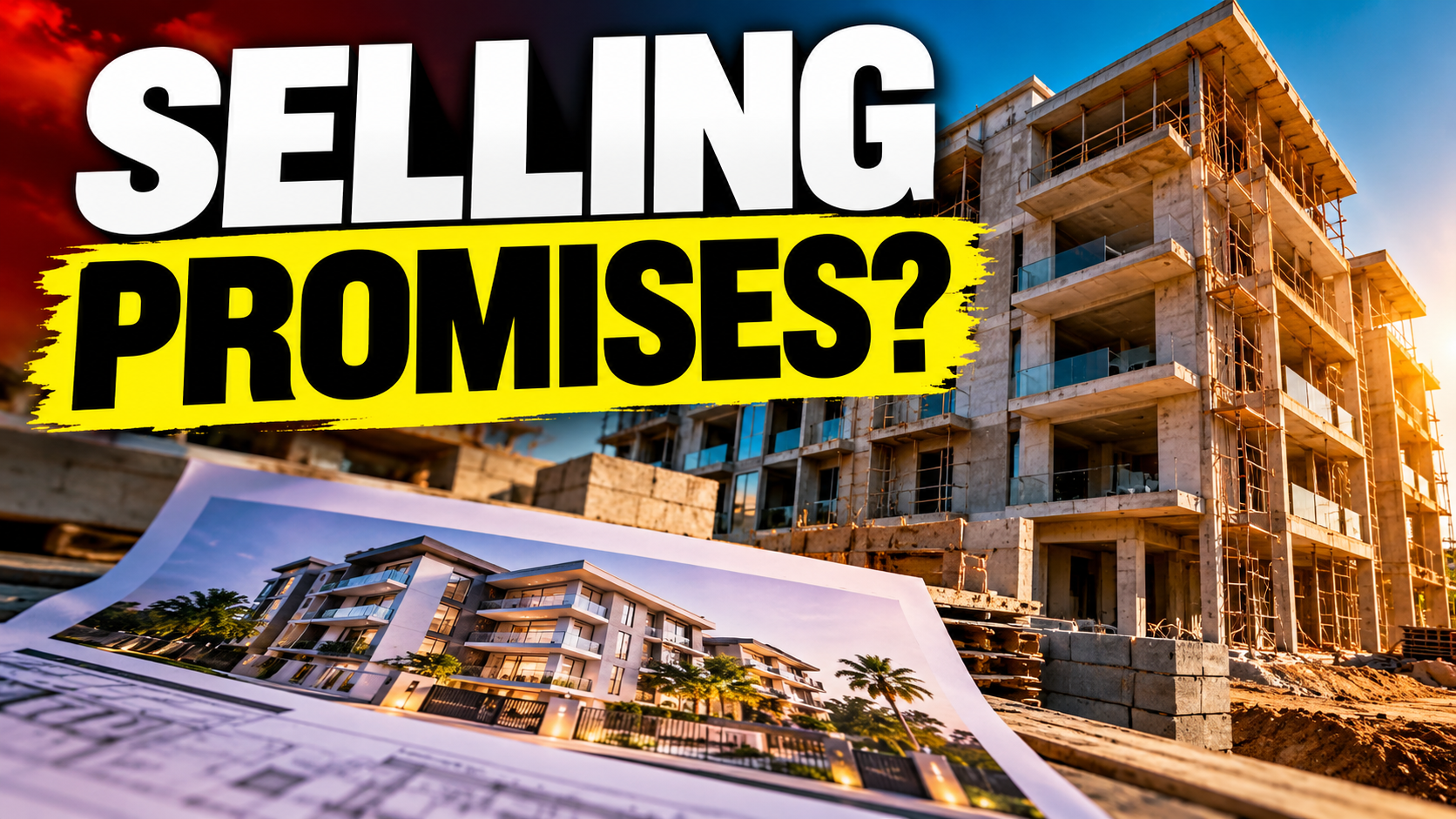
Instead of inspecting a finished building, buyers make purchasing decisions based on architectural drawings, property brochures, three-dimensional renderings, proposed specifications, and contractual promises.
A typical transaction involves a reservation deposit followed by installment payments during construction.
For example, a developer might advertise a two-bedroom apartment in Accra for $120,000, allowing buyers to secure the property with a 20% or 30% deposit.
The remaining amount is then paid according to an agreed schedule.
For buyers, this arrangement can make property ownership more accessible because they do not necessarily need to pay the full purchase price immediately.
For developers, however, off-plan sales serve another important purpose: financing construction.
That is where the debate becomes interesting.
WATCH FULLL VIDEO BELOW
Are Property Buyers Financing Developers Without Realizing It?
Property development requires considerable financial resources.
Before construction begins, a developer may need to acquire land, complete architectural designs, secure building permits, engage contractors, and purchase construction materials.
Instead of financing every stage through bank loans or private investment, developers can use money collected from off-plan buyers to support project development.
Consider a hypothetical residential project containing 40 apartments.
If each apartment costs $120,000, the total potential sales value would be $4.8 million.
Suppose the developer sells 20 apartments and collects a 30% deposit from each buyer.
That would generate $720,000 before those buyers receive their completed properties.
Depending on the contractual arrangements, this money may become part of the developer’s construction financing.
The problem arises when buyers are not adequately protected against delays, financial difficulties, or project failure.
What happens if the developer spends a substantial portion of those deposits but cannot complete the project?
What happens if construction costs rise beyond the original budget?
And what happens if the developer becomes insolvent?
The buyer may discover that purchasing an off-plan apartment has exposed them to risks similar to financing a construction business.
This does not mean every off-plan development is unsafe. Many reputable developers successfully deliver projects.
However, buyers must understand how their money is handled and what protections exist if the project does not proceed as promised.
The Biggest Risks of Buying Off-Plan Property in Ghana
1. Construction Delays and Missed Completion Dates
One of the biggest concerns associated with off-plan property investment is construction delay.
Imagine purchasing an apartment scheduled for completion within 24 months.
You make the required payments and plan your finances around the promised delivery date.
Two years later, construction is still ongoing.
The developer requests another six months.
Six months become twelve, and your apartment remains unfinished.
For someone intending to occupy the property, the delay may mean continuing to pay rent elsewhere.
For an investor, it can mean missing expected rental income and postponing investment returns.
Even when delays arise from legitimate construction difficulties, buyers need clear contractual remedies and realistic completion schedules.
2. Changes to Building Specifications
Off-plan buyers often make purchasing decisions based on advertised designs, floor plans, amenities, and finishing materials.
However, the completed property may differ from the original presentation.
Developers sometimes make substitutions because of construction costs, material availability, technical requirements, or design changes.
While some modifications may be reasonable, material changes can affect the property’s value and the buyer’s expectations.
Buyers should therefore ensure that the sales agreement clearly identifies essential specifications and explains what happens when significant changes are proposed.
3. Developer Insolvency and Abandoned Projects
The most serious risk is the possibility that a development will never be completed.
If a developer experiences financial difficulties, construction may slow down or stop entirely.
Buyers who have already paid substantial deposits could face complicated legal proceedings to recover their money.
A signed sales agreement does not automatically guarantee repayment.
Recovery depends on factors such as the contract, the buyer’s legal interest, available security, applicable law, and the developer’s financial position.
Without adequate protections, buyers may find themselves holding contractual claims rather than completed properties.
4. Misleading Marketing and Unrealistic Investment Promises
Another concern is the way some off-plan developments are advertised.
Marketing campaigns may emphasize luxury facilities, projected rental income, expected capital appreciation, and attractive introductory prices.
But projected returns are not guaranteed.
A property advertised as having strong investment potential may ultimately generate lower rental income or appreciate more slowly than anticipated.
Buyers should distinguish between verified facts, contractual commitments, and marketing projections.
An attractive architectural rendering is not proof of financial viability.
Why Developers Prefer Off-Plan Property Sales
Despite these concerns, banning off-plan transactions could create serious challenges for Ghana’s construction industry.
Real estate development requires substantial capital, and obtaining affordable long-term financing can be difficult.
Off-plan sales allow developers to secure early buyers, assess market demand, and reduce their dependence on external borrowing.
The model can also help smaller developers compete with large property companies that have access to substantial financial resources.
Removing this financing option could discourage certain residential developments.
Some developers might be forced to secure more expensive financing, potentially increasing housing prices.
Others might abandon projects before construction begins.
As a result, a complete ban could produce unintended consequences for housing supply, development competition, and affordability.
This is why the debate must consider both consumer protection and the practical realities of property development.
Why Buyers Continue to Invest in Off-Plan Properties
Off-plan property purchases can offer genuine advantages.
Lower Entry Prices
Developers may offer introductory prices below the amounts they expect to charge when construction is completed.
Buyers who enter early may benefit if the development succeeds and market values rise.
However, appreciation is never guaranteed.
Flexible Payment Arrangements
Some buyers prefer installment payments because they can spread the purchase cost over an agreed period.
This arrangement can be particularly attractive to professionals and Ghanaians living abroad who intend to finance property purchases through ongoing income.
Greater Choice and Customization
Early buyers may have more freedom to select preferred floors, apartment layouts, views, or available finishing options.
These benefits explain why off-plan transactions remain attractive.
The challenge is ensuring that buyers fully understand the risks they accept in exchange for those advantages.
What Does Ghana’s Real Estate Law Say About Buyer Protection?
Ghana’s real estate sector is subject to various laws and regulatory requirements.
One important piece of legislation is the Real Estate Agency Act, 2020 (Act 1047), which established the Real Estate Agency Council.
The Council has responsibilities relating to real estate agency practice, licensing, professional conduct, and regulatory oversight within its statutory mandate.
However, regulation of real estate agency practice should not be confused with a comprehensive guarantee that every off-plan development is financially secure.
A developer’s ability to complete a project depends on factors including project financing, land rights, building approvals, construction management, and contractual obligations.
Similarly, the involvement of a licensed real estate professional does not automatically guarantee that a buyer’s payments are protected against developer insolvency.
Ghana needs to consider whether its existing regulatory and contractual protections sufficiently address the distinctive financial risks associated with off-plan developments.
The central question is not merely whether laws exist.
It is whether buyers have effective protection when property developers fail to deliver.
Should Ghana Require Escrow Accounts for Off-Plan Property Sales?
One reform worth considering is stronger protection for buyers’ deposits.
Under an appropriately structured escrow arrangement, customer payments could be held by an independent party and released according to specified contractual conditions.
For instance, payments might be linked to independently verified construction milestones.
Funds could be released when the foundation, structural frame, roofing, installations, and other agreed stages have been completed.
This could help reduce the risk of substantial buyer funds being used without corresponding construction progress.
However, escrow accounts are not a complete solution.
Developers still require money to begin construction, and escrow arrangements must be designed carefully to avoid making legitimate projects financially impossible.
Other safeguards could include performance guarantees, project-specific financial disclosures, suitable insurance arrangements, or a combination of protections.
The objective should be to reduce unreasonable buyer exposure while maintaining access to legitimate development financing.
Should Developers Prove Their Financial Capacity Before Selling?
Another potential reform involves establishing stronger requirements before developers begin marketing major off-plan projects.
Developers could be required to provide evidence of credible financing arrangements, realistic construction budgets, and contingency planning.
For larger developments, independent financial assessments might help establish whether the proposed project is reasonably capable of completion.
Such requirements would not eliminate every risk.
Even well-financed projects can experience unexpected difficulties.
Nevertheless, financial verification could discourage developers from launching projects based entirely on optimistic sales assumptions.
Any new rules should also recognize the differences between small residential developments and large commercial apartment projects.
Proportionate regulation would be essential to avoid excluding responsible smaller developers from the market.
Should Ghana Introduce Mandatory Completion Deadlines and Refund Protection?
Completion dates are among the most important details in an off-plan sales agreement.
Buyers often make major financial and personal decisions based on promised handover dates.
If construction is delayed, the contract should clearly explain the consequences.
A stronger consumer protection framework could require developers to disclose realistic completion schedules, permitted extensions, buyer remedies, and refund procedures.
Where appropriate, contracts could also provide compensation for certain unjustified delays.
Importantly, legitimate delays caused by exceptional circumstances should be distinguished from avoidable problems resulting from poor planning or financial mismanagement.
A fair system should protect buyers while recognizing the genuine uncertainties involved in construction.
Why Diaspora Buyers Must Be Particularly Careful
Ghanaians living in the United Kingdom, United States, Canada, Germany, Austria, and other countries are an important audience for off-plan property marketing.
Many diaspora buyers are attracted by the opportunity to acquire homes or investment properties without paying the full purchase price immediately.
However, distance creates additional challenges.
A buyer living overseas may not be able to visit the construction site frequently.
They may depend on information provided by the developer, sales agents, or relatives.
This makes independent verification particularly important.
Before purchasing an off-plan property in Ghana, diaspora investors should consider engaging an independent property lawyer and qualified construction professional.
Land ownership, development approvals, building specifications, payment protections, and construction progress should be verified through appropriate channels.
Buyers should also avoid assuming that a prestigious location or attractive marketing campaign guarantees a secure investment.
Seven Things to Verify Before Buying Off-Plan Property in Ghana
- Land ownership and legal rights: Confirm the developer’s legal interest in the land and authority to develop and sell the proposed property.
- Building permits and approvals: Verify that the relevant development and construction approvals have been obtained.
- Developer track record: Investigate previously completed developments and any known unresolved delivery issues.
- Construction financing: Understand how the project is funded and whether the developer has credible arrangements to complete construction.
- Payment protection: Determine where deposits are held and what security or refund protections exist.
- Completion date and specifications: Ensure the contract clearly states the agreed handover arrangements, material specifications, and remedies for significant changes or delays.
- Independent professional advice: Engage a qualified Ghanaian property lawyer and, where appropriate, an independent surveyor or construction specialist before committing substantial funds.
Taking these precautions does not eliminate every risk, but it can significantly improve the quality of a buyer’s investment decision.
Should Ghana Ban Off-Plan Property Sales Completely?
A complete ban might appear attractive because it would prevent certain risks associated with purchasing unfinished properties.
However, prohibition could also eliminate a financing mechanism that supports legitimate housing developments.
It might make construction more dependent on bank loans and institutional finance, potentially increasing costs and reducing opportunities for smaller developers.
A more practical approach could involve stricter regulation rather than outright prohibition.
Ghana could consider targeted reforms, including:
- Independent verification of major off-plan projects before public sales begin.
- Greater transparency around developer financing and project risks.
- Stronger safeguards for customer deposits.
- Construction milestone-based payment protections where feasible.
- Clear contractual completion deadlines and refund rights.
- More effective enforcement against materially misleading advertising and serious developer misconduct.
- Accessible dispute resolution mechanisms for buyers.
These are proposed reforms for public discussion, not a claim that all such requirements currently apply universally in Ghana.
The aim should be to establish a property market where responsible developers can raise capital while customers receive meaningful financial protection.
The Real Problem Is Not Selling Unfinished Properties. It Is Selling Unprotected Promises.
Off-plan property development is not inherently dishonest.
It is a legitimate business model that can provide financing flexibility and purchasing opportunities.
The problem arises when buyers commit large sums without adequate information, enforceable safeguards, or realistic options for recovering their money if a development fails.
A responsible property market should not depend entirely on trust.
It should operate through transparent contracts, sound financing, verifiable project information, and effective accountability.
Developers who consistently deliver projects should benefit from a regulatory environment that distinguishes them from businesses making unrealistic commitments.
Buyers should also understand that a discount on an unfinished property is not free money.
It is partly compensation for accepting uncertainty.
That risk must be understood, evaluated, and managed.
Final Thoughts: Ghana Must Protect Property Buyers Without Destroying Development
Should Ghana ban off-plan property sales?
My position is that an outright ban may be excessive, but stronger buyer protections deserve serious consideration.
Ghana needs investment in residential construction.
It needs credible property developers, functioning housing markets, and opportunities for individuals to become homeowners.
But it also needs a system where people do not lose their life savings because they placed their trust in a project that was poorly financed or inadequately managed.
Buying property should be a pathway toward greater financial security, not an uncontrolled gamble on someone else’s ability to complete construction.
The future of Ghana’s real estate market should be built on transparency, financial discipline, professional accountability, and enforceable consumer protection.
Because real estate investment is not just about acquiring buildings.
It is about protecting capital, creating long-term value, and building wealth that lasts.
Join the Conversation
Do you think Ghana should ban off-plan property sales completely?
Should developers be required to reach a specific stage of construction before they can collect payments from buyers?
Or should the government focus on stronger financial safeguards and better enforcement?
Share your thoughts and experiences in the comments.
For more discussions on Ghana’s real estate market, property investment, business opportunities, and wealth creation in Africa, follow Kumadoh Perspective.
Kumadoh Perspective — Let’s Build Wealth That Lasts.
Disclaimer: This article is intended for general educational and informational purposes. It does not constitute legal, investment, or financial advice. Property laws, regulatory requirements, and contractual protections should be independently verified with qualified professionals before making investment decisions.