
Ghana’s logistics industry rarely attracts the same attention as banking, real estate, telecommunications or technology. Yet almost everything consumed, constructed, exported or sold in Ghana depends on logistics.
The cement used to build a house must reach the construction site. A retailer in Accra needs stock transported from a warehouse. Agricultural products must travel from farms to markets. Imported goods arriving at Tema Port must eventually reach businesses and consumers. Manufacturers need raw materials delivered and finished products distributed.
Behind almost every commercial transaction is another transaction that receives far less attention: How does the product actually get from one place to another?
That question is becoming increasingly important as Ghana’s economy becomes more urbanised, digitally connected and dependent on faster movement of goods. And Ghana’s logistics challenge may not simply be that the country needs more trucks. It may be that Ghana needs a much better system for coordinating the trucks, warehouses, ports, businesses, drivers and customers it already has.
Logistics Is Part of Ghana’s Economic Infrastructure
It is easy to think of logistics as simply trucks moving along highways. In reality, the sector is much broader. It includes road freight, ports, warehouses, cargo handling, freight forwarding, last-mile delivery, construction haulage, cold-chain transportation, distribution centres, customs processes and increasingly the software used to coordinate these activities.
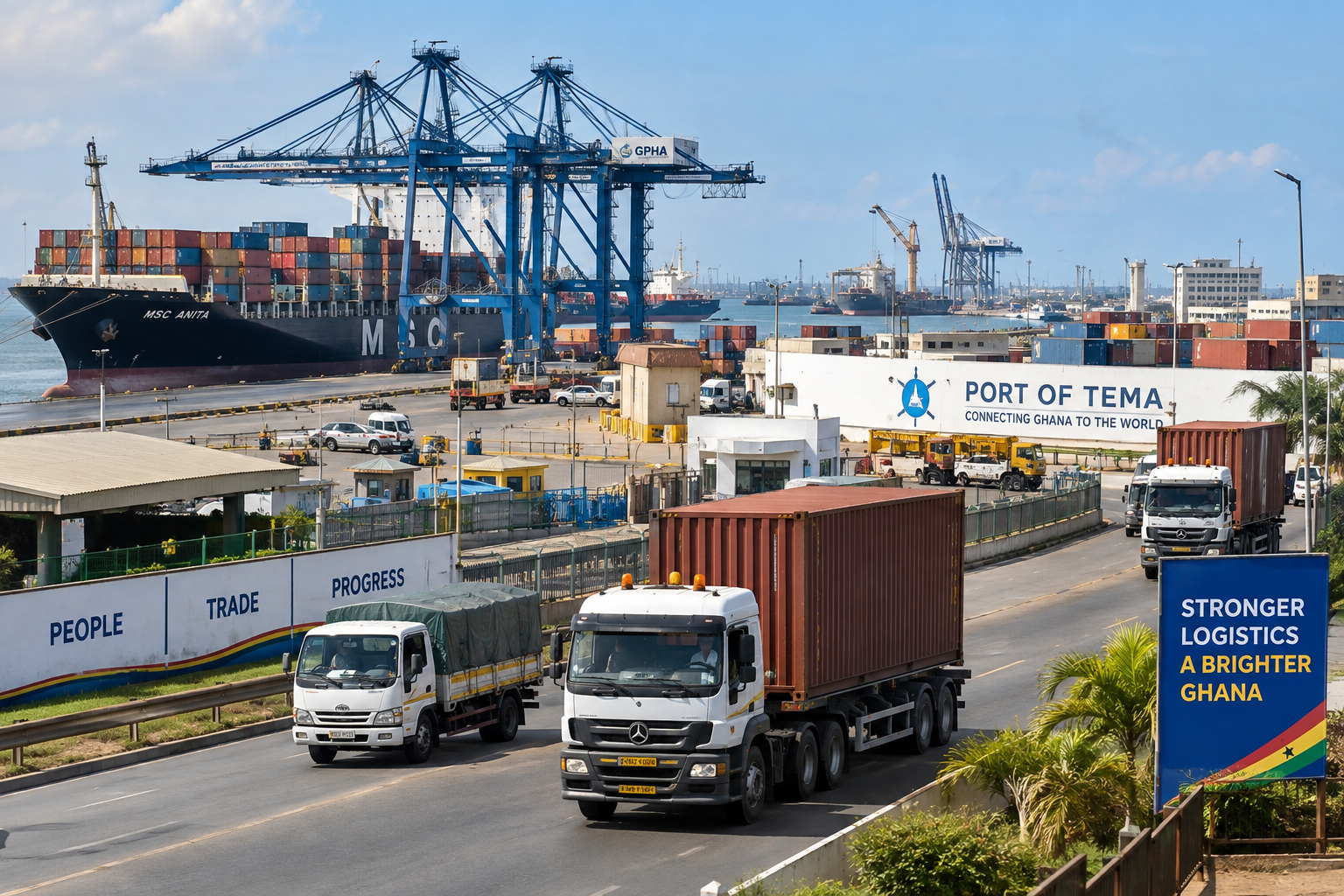
Ghana’s ports demonstrate just how important this system is. A significant proportion of Ghana’s international trade passes through the Tema and Takoradi ports. Tema, in particular, is surrounded by warehouses, freight forwarders, transport companies, factories and inland logistics operations.
But getting goods into the country is only part of the logistics equation. A container sitting at a port has little economic value until its contents can reach a factory, warehouse, shop, construction site or customer. That is where domestic transportation becomes critical.
Ghana Remains Heavily Dependent on Roads
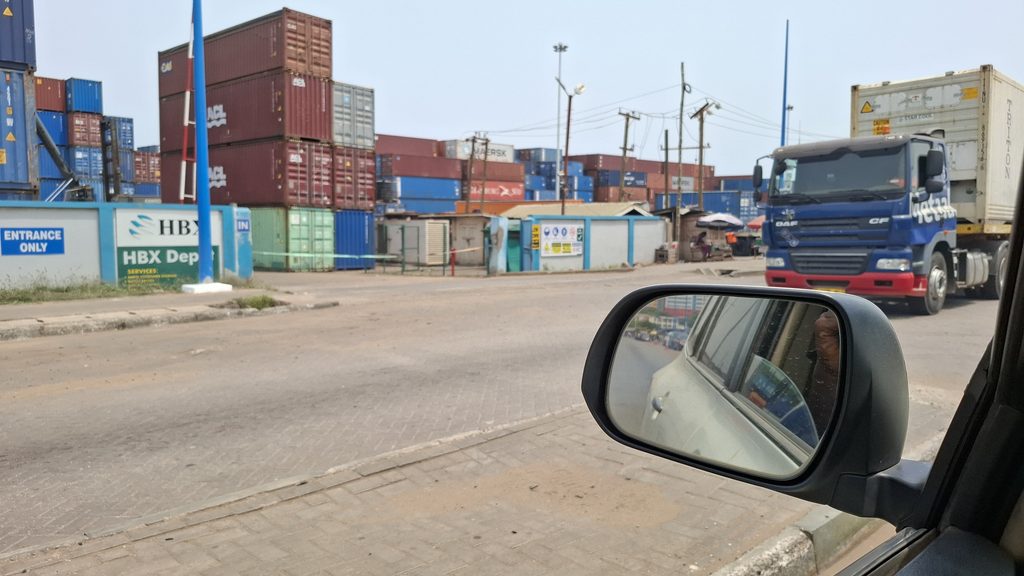
Road transportation carries an enormous share of passenger and freight movement within Ghana. This dependence has consequences.
Heavy trucks compete with passenger vehicles on major highways. Congestion increases travel times. Poor road conditions can increase vehicle maintenance costs. Long-distance trucking becomes sensitive to fuel prices, breakdowns and delays.
For a business owner, these are not abstract transport problems. They eventually become business costs. If transporting goods becomes expensive, the retailer may increase prices. If materials arrive late, construction slows. If agricultural produce cannot reach markets efficiently, some of its economic value can be lost before it reaches consumers.
Improving logistics therefore has implications far beyond the transportation industry itself.
Tema Port Shows Why Logistics Cannot Be Viewed in Isolation
Tema Port illustrates an important point: logistics is a chain. A delay at one part of that chain can affect everything that follows.
Imagine what happens when a container is delayed. A truck scheduled to collect it may have to wait. A warehouse expecting the cargo may reorganise operations. A retailer waiting for inventory may run short of stock. A contractor waiting for imported equipment may delay work.
The original problem may have occurred at the port, but its effects move throughout the supply chain. This is why serious logistics development cannot focus only on building roads or buying trucks. Ghana needs infrastructure, but it also needs better coordination.
The Country Needs More Multimodal Transport
Ghana also needs to think beyond road transport alone. Railways, ports, inland waterways and road transportation can potentially complement one another.
Heavy bulk goods may be more efficient by rail or water over certain distances, while trucks remain essential for the first and final legs of the journey. The challenge is making those systems connect efficiently.
That means the future of logistics should not be viewed as trucks versus rail or ports versus roads. The stronger model is an integrated network in which different transportation modes are used where they make the most economic sense.
But Ghana’s Logistics Problem Is Also Highly Fragmented
Infrastructure receives much of the attention, but there is another problem that is less visible. The market itself is fragmented.
Thousands of commercial drivers and vehicle owners operate independently. Businesses maintain private lists of drivers. Customers ask friends for truck recommendations. Contractors call different vehicle owners whenever they need sand, stone or building materials moved. Drivers may spend hours looking for work even when customers nearby are looking for exactly the type of vehicle they operate.
The information exists. The vehicles exist. The demand exists. But they do not always meet efficiently.
Consider a simple example. A furniture company in East Legon needs a truck to deliver furniture to Tema. Somewhere nearby, a driver with the correct vehicle may be idle. Traditionally, there may be no efficient mechanism connecting those two parties.
The furniture company calls three drivers. The first is unavailable. The second vehicle is too small. The third quotes a price, but the company has little basis for comparing it. Meanwhile, another suitable truck may be sitting unused several kilometres away.
That is fundamentally an information problem. And information problems are exactly where technology can become useful.
Ghana’s Logistics Sector Is Gradually Going Digital
Digital logistics does not simply mean putting a booking form online. A useful digital logistics system should make previously invisible information easier to see.
Which vehicles are available? What type of vehicle is suitable? Where is the cargo? Who is carrying it? When should it arrive? How much was the customer charged? Was delivery confirmed? What happened on previous deliveries?
Once those questions become digitally recorded, logistics becomes easier to manage. This is where Ghanaian logistics technology companies and marketplaces are beginning to explore new models.
Cargo Marketplaces Could Become Part of That Transition
One emerging model is the digital cargo marketplace. Instead of a transport company owning every truck on the platform, the marketplace connects independent transport capacity with customers who need it.
A customer posts a transportation requirement. Drivers with appropriate vehicles can respond. The customer can compare options. The platform provides some combination of identity verification, job records, communication, tracking and payment infrastructure.
This model is already familiar in other industries. Hotels do not need to be owned by a travel-booking platform. Sellers do not need to be owned by an e-commerce marketplace. Drivers do not necessarily need to be employees of a ride-hailing platform. Logistics marketplaces apply a similar principle to cargo.
Where CargoMov Fits In
One Ghanaian example attempting to apply this model to cargo transportation is CargoMov Ghana.
CargoMov is a Ghana-focused digital logistics marketplace connecting customers and businesses with drivers for cargo transportation, truck hire, moving, construction haulage and other logistics requirements. Rather than operating only as a traditional trucking company, the platform allows customers to describe what needs to be transported and receive offers from suitable drivers.
Customers who already know what they need to move can use CargoMov’s Post a Cargo Job service to provide pickup and delivery locations, cargo information, vehicle requirements and other details.
For people primarily looking for commercial vehicles, CargoMov also operates a dedicated Truck Rental Ghana section. Its wider range of transportation options can be explored through the CargoMov Services page.
CargoMov is useful here not because one platform will solve Ghana’s logistics challenges, but because it represents the kind of structural change taking place within the sector.
The move is from finding a truck through somebody you know toward finding available transport capacity through organised digital information.
That transition could eventually be significant.
Technology Does Not Automatically Solve the Problem
It is important, however, not to confuse digitisation with efficiency. A logistics application is only useful when the physical operation behind it works.
A beautiful interface cannot compensate for:
- Unreliable drivers
- Inaccurate cargo descriptions
- Poorly maintained vehicles
- Unsafe loading
- Weak customer support
- Pricing disputes
- Incorrect addresses
- Poor road conditions
- Vehicle breakdowns
- Failed delivery communication
Platforms such as CargoMov and any competitors that emerge will therefore ultimately be judged less by their technology alone and more by the quality of the logistics network behind that technology.
Verification must actually work. Disputes must be handled properly. Drivers need enough jobs to remain active. Customers need enough vehicle availability to trust the marketplace. And logistics companies still need competent people managing operations behind the scenes.
Technology can organise logistics. It cannot replace good logistics management.
The Driver Side of the Logistics Equation
Digital logistics should also be considered from the driver’s perspective. Commercial vehicles are expensive assets.
A truck that spends too many days parked without work is not producing income, even though the owner may still be paying for insurance, maintenance, financing and other operating expenses. Digital marketplaces can potentially help reduce that gap by giving drivers access to cargo requests outside their immediate network of existing customers.
For example, commercial drivers interested in joining CargoMov can apply through its Become a CargoMov Driver platform.
The broader economic question is whether technology can help Ghana make more efficient use of existing commercial vehicle capacity instead of assuming that every transportation problem requires adding more vehicles to the system.
Construction Could Be One of the Biggest Opportunities
Construction deserves particular attention. Ghana continues to build homes, apartments, roads, commercial buildings and other infrastructure. Every one of those projects requires transportation.
Sand needs tipper trucks. Stone and chippings require haulage. Blocks have to reach construction sites. Cement moves from distributors. Steel and equipment require appropriate vehicles.
Yet construction logistics often remains fragmented. A contractor may have one number for sand, another for blocks, another for a crane truck and several different truck drivers saved on WhatsApp. Digital platforms could eventually make this process more structured.
CargoMov, for example, has developed a dedicated Construction Materials and Delivery section covering construction supply and transportation requirements.
The larger opportunity is not simply selling construction materials online. It is creating visibility between suppliers, contractors, drivers and projects.
Suppliers Could Also Become Part of Digital Logistics
Once construction logistics becomes digital, another participant enters the ecosystem: the supplier. A contractor does not only need a truck. The contractor may also need sand, cement, stone, blocks, roofing materials or steel.
Connecting transportation with supply could create a more integrated construction procurement system. CargoMov provides a separate Supplier Portal for businesses interested in participating in its marketplace.
Whether this type of model becomes widespread remains to be seen, but it demonstrates how logistics platforms may gradually expand beyond transportation into broader supply-chain coordination.
SMEs May Benefit Even More Than Large Corporations
Large companies can build their own fleets. Small businesses often cannot.
A growing furniture business may need a truck three times this week and none next week. A retailer may need extra delivery capacity before Christmas. A small distributor may suddenly win a large contract. Buying trucks for occasional peak demand may make little financial sense.
This is where shared logistics capacity becomes interesting. Instead of every business owning enough vehicles for its busiest possible day, businesses can access transportation when needed. In economic terms, it allows an underutilised asset somewhere in the market to meet demand somewhere else.
Companies interested in a more structured system for recurring transportation can use platforms such as the CargoMov Corporate and Business Account, while other logistics providers may develop similar solutions.
The important trend is not one particular platform. It is the gradual shift from informal logistics coordination toward systems that can provide businesses with records, visibility and greater control.
Logistics Data Could Become Almost as Important as Logistics Vehicles
There is another opportunity that receives less attention: data. Traditional informal logistics produces very little usable information.
A delivery takes place. Someone pays the driver. Everyone moves on.
But when transportation becomes digital, businesses can begin asking better questions.
How much did we spend transporting goods between Accra and Kumasi last year? Which route produces the most delays? How frequently do we hire 20-foot trucks? Which supplier creates the longest loading time? Which branch requires the most deliveries? What percentage of deliveries arrive late?
Once companies have this information, logistics becomes something that can be analysed rather than simply endured. For Ghanaian businesses trying to become more efficient, that could be one of the most important long-term benefits of logistics digitisation.
Logistics Access May Also Need Human Intermediaries
Not every customer will immediately become comfortable booking logistics entirely through an application. Ghana’s economy still contains a significant amount of relationship-based commerce.
Some customers may prefer speaking with someone who helps them describe their cargo, choose a vehicle and arrange transportation. That means the future of digital logistics may not be completely self-service.
Hybrid models could emerge in which technology powers the transaction while local agents help customers access the system. CargoMov, for example, has introduced a CargoMov Agent model intended to allow approved agents to assist customers with bookings.
This is an interesting example of how digital platforms may have to adapt to local customer behaviour rather than expecting customers to adapt entirely to technology.
Ghana Could Also Become a Regional Logistics Hub
Ghana’s geographic position creates an opportunity larger than its domestic market. Tema already serves not only Ghana but also regional trade connected with landlocked West African countries.
The country’s ports, highways, future rail connections and inland transport systems therefore have implications for trade beyond Ghana’s borders. If these systems improve, Ghana could strengthen its role as a gateway between global shipping and inland West Africa.
But infrastructure alone will not create that advantage. Customs processing, warehousing, freight technology, professional transport operators and digital coordination will matter too.
The Future Will Probably Be a Combination of Old and New
Traditional transport businesses are unlikely to disappear. Neither should they.
Ghana will still need independent truck drivers. It will still need fleet operators. It will still need freight forwarders, haulage companies, warehouses, movers, clearing agents and logistics professionals.
What will change is how these businesses find customers and manage information.
A truck driver who previously depended entirely on personal referrals may eventually receive work through multiple digital marketplaces. A company that once organised every delivery through phone calls may manage transportation from a central logistics dashboard. A construction company may digitally coordinate material orders, trucks and delivery confirmation. A warehouse may know exactly when the next vehicle will arrive.
That is not the replacement of logistics. It is the organisation of logistics.
Ghana’s Logistics Opportunity Is Bigger Than Delivery Apps
The conversation about logistics technology in Ghana should therefore go beyond asking whether the country needs another delivery app.
The real question is: Can Ghana create a more efficient system for moving physical goods throughout the economy?
That requires better roads, better rail, more efficient ports, inland logistics infrastructure, reliable commercial vehicles, professional drivers, warehousing, better regulation, better data and digital systems capable of connecting these components.
Platforms such as CargoMov represent one small part of that much larger transformation. Their significance will depend on whether they can solve real operational problems rather than simply digitising existing inefficiencies.
Readers interested in understanding CargoMov’s model can explore the CargoMov About page, while answers to common questions about bookings, drivers and logistics operations are available through the CargoMov FAQ.
Final Thoughts
Logistics is one of those industries people rarely notice when it works. But when it fails, almost everyone feels it.
The builder waiting for cement feels it. The supermarket waiting for stock feels it. The importer waiting for cargo feels it. The farmer trying to reach the market feels it. The driver without enough jobs feels it. And eventually, the consumer paying higher prices feels it.
Ghana’s next stage of logistics development therefore cannot be reduced to simply putting more trucks on the road. The country needs to make better use of the infrastructure, vehicles, businesses and people already moving goods every day.
Physical infrastructure will remain essential. But increasingly, information infrastructure will matter too.
Knowing what needs to move, which vehicle can move it, where that vehicle is, what the journey costs and whether the delivery was successfully completed may sound simple. At scale, however, that information could reshape how goods move through Ghana.
CargoMov is one example of a Ghanaian company attempting to build part of that digital infrastructure, alongside the many existing logistics, haulage and transportation businesses that already keep the economy moving.
For anyone researching the platform, the main CargoMov website provides information about its marketplace, while customers with an immediate transportation requirement can post a cargo job.
And that may be where the most interesting chapter of Ghana’s logistics industry is only beginning.