
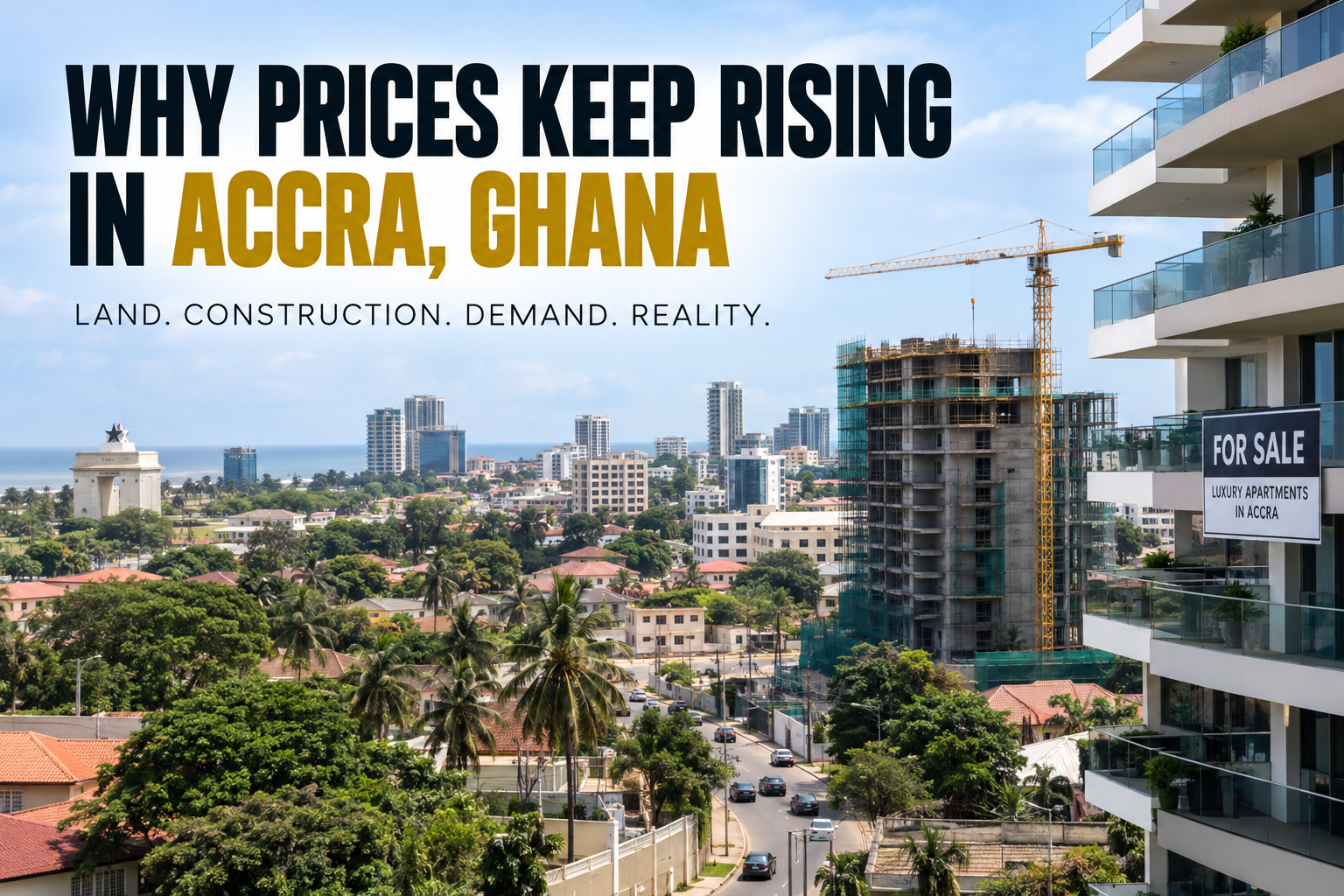
By Uriah Kumadoh | Kumadoh Perspective
Imagine saving towards a home, getting closer to your deposit, and then discovering that the seller has increased the asking price.
The property has not gained another bedroom. The road outside has not necessarily improved. Your income has not increased at the same rate.
Yet the amount you need to buy it has changed.
That situation raises an important question: Is the property becoming more valuable, or is it simply becoming more expensive?
Understanding why property prices keep rising in Accra requires looking beyond the familiar explanation that “everyone wants to live in the capital.” It also requires separating the cost of land, the cost of construction, and the amount a buyer actually agrees to pay.
Most importantly, a rising advertised price should never be treated as proof that an investment is getting better.
Watch: Why Prices Keep Rising in Accra, Ghana
First, Are All Property Prices in Accra Actually Rising?
Before discussing the causes, we need to question the measurement.
An asking price is what a seller wants. A completed transaction price is what a buyer actually pays. Construction costs measure something different again.
For example, Ghana Property Centre describes its Accra house-price report as a calculation based on the median of properties listed on its platform. That is useful information about advertised properties, but it is not a record of completed sales across the entire market.
There is also a comparison problem. Suppose one month’s listings contain mostly modest family homes, while the next month includes more large, high-end houses. The typical advertised price could rise without any individual property becoming more valuable.
This is why a headline about “Accra property prices” needs context. A figure covering different neighbourhoods, property sizes and building conditions cannot tell you what one particular home is worth.
The question is not simply whether prices are rising. It is which prices, for which properties, and according to what evidence.
Urban Growth Creates More Housing Need
Ghana’s population has become more urban over time. The 2021 Population and Housing Census recorded an increase in the urban share of the population from 50.9% in 2010 to 56.7% in 2021. Greater Accra and Ashanti together accounted for 47.8% of the increase in the urban population over that period.
The same census also found that average urban household size declined from 4.1 people to 3.3 people between 2010 and 2021. That matters because smaller households can require more separate homes for the same number of residents.
The implication is straightforward: housing demand is not only about population growth. It is also about how people organise their lives.
Young adults forming independent households, couples moving into their own accommodation and families seeking different living arrangements can all add to the need for separate housing.
However, there is an essential distinction:
Needing a home is not the same as being able to afford the homes being offered.
Population growth does not, by itself, prove that a particular apartment will sell quickly or that a landlord can charge any rent they choose.
The Real Constraint Is Not Just Land, but Usable, Well-Connected Land
When discussing land prices in Accra, it is tempting to argue that Ghana has plenty of land, so housing should be inexpensive.
But an available plot and a practical residential building site are not necessarily the same thing.
The World Bank’s Ghana Urbanization Review identified land-market constraints, insecure property rights and the need to coordinate land development with infrastructure and affordable housing. These are longstanding structural issues, rather than evidence that every plot is currently appreciating.
Consider two hypothetical plots of equal size.
One has verified ownership, dependable access, nearby utilities and a location that works for the intended occupants. The other requires additional infrastructure, has uncertain access and needs further investigation before construction can begin.
Their purchase prices alone would not reveal their full economic differences.
For buyers, the useful calculation is therefore:
Land purchase price + verification costs + site preparation + infrastructure requirements + construction costs.
A lower-priced plot may still be the better choice. But that conclusion should follow an assessment of the complete project, not simply the amount advertised for the land.
Construction Costs Can Still Rise While Inflation Falls
One of the most important distinctions in Ghana’s property conversation is the difference between slower inflation and falling prices.
The Ghana Statistical Service reported year-on-year building-cost inflation of 4.0% in July 2026, compared with 14.2% in July 2025. That means building costs were still higher overall than a year earlier, but the rate of increase was much lower. The index measures construction inputs, not the selling prices of homes in Accra.
Here is a hypothetical example.
A building input costs GH₵100. After a 20% increase, it costs GH₵120. The following year, its price rises by only 5%, reaching GH₵126.
Inflation has slowed significantly, but the price has not returned to GH₵100.
This is why a lower inflation announcement does not automatically mean a developer can deliver a house at a price from several years ago.
Equally, buyers should question blanket explanations. A seller who says “everything has become more expensive” should be able to explain the actual cost changes affecting that particular project.
Currency Movements Can Affect the Cost of Building
Construction can also be exposed to exchange-rate changes through imported materials and equipment. The Centre for Affordable Housing Finance in Africa’s 2024 Ghana profile identified imported building materials and currency volatility as relevant pressures on housing affordability.
The mechanism is easier to understand through an illustration.
Suppose imported equipment costs US$10,000. At a hypothetical exchange rate of GH₵10 to the dollar, its converted cost is GH₵100,000. At GH₵12 to the dollar, the same equipment costs GH₵120,000 before other charges.
The equipment has not improved. Its dollar price has not changed. But its cedi cost has increased.
The reverse calculation also matters. Currency movements can ease some costs as well as increase them. A serious assessment should use current quotations rather than assume that exchange-rate pressure always moves in one direction.
There is a separate compliance issue: the Bank of Ghana has reiterated restrictions on pricing, advertising and receiving or making payments for goods and services in foreign currency in Ghana. Buyers should have a qualified adviser review the currency and payment provisions of their transaction.
Financing and Delays Affect How Quickly Homes Reach the Market
The supply of housing depends on more than how many people begin building.
Research by academics at the London School of Economics and the University of Ghana describes the important role of self-building financed through cash and savings, rather than mortgage finance, in Ghana’s housing economy.
Consider what happens when a household builds only as money becomes available. The foundation may be completed this year, the structure later, and the finishing work at another stage.
Until the building becomes habitable, it does not provide the same housing service as a completed home.
For a developer using borrowed money, delays can create a different problem. Additional months may mean additional financing costs, site supervision, security and other expenses. A developer might then try to recover those costs through a higher selling price.
But there is an important limit to that reasoning:
A developer’s higher costs do not guarantee that buyers will accept a higher price.
Expensive borrowing can also reduce buyers’ purchasing power. The result may be slower sales, a redesigned project, a negotiated discount or a postponed development—not necessarily continuing price growth.
Luxury Housing and Affordable Housing Can Face Different Conditions
A city can have a shortage of affordable homes and still have difficulty absorbing expensive apartments.
The CAHF’s 2024 Ghana profile described an oversupply of luxury accommodation alongside a persistent shortage of low-income housing. It also discussed investment from local buyers, expatriates and foreign nationals, including activity in Accra’s prime property market.
The lesson is not that one group of buyers is responsible for every price increase. It is that different households have different budgets, financing arrangements and reasons for buying.
Imagine a development designed around buyers who can pay a large deposit and purchase a second home. That development may do very little to solve the housing problem of someone seeking an affordable primary residence.
Both groups need property, but they are not necessarily competing for the same product.
This also explains why a national housing shortage is not sufficient evidence for a particular investment.
Before buying, ask:
Who can afford this property, who genuinely needs it, and what competing options do they have?
Without those answers, “housing demand is high” is too broad to justify the purchase.
Seller Expectations Can Rise Without a Completed Sale
There is another reason to be careful with advertised prices: sellers can change their expectations before the market validates them.
Consider this hypothetical sequence.
A homeowner advertises at GH₵2 million. A neighbouring owner then lists a somewhat similar property at GH₵2.3 million. A third seller sees both advertisements and decides to ask GH₵2.5 million.
The visible prices have increased.
But until transactions occur, those figures tell us more about the sellers’ expectations than about the amounts buyers will pay.
This is especially relevant when reading listing-based market reports. Ghana Property Centre’s methodology explicitly uses listed properties; it should therefore be interpreted as asking-price evidence rather than proof of completed transaction values.
For a buyer, the practical response is not to dismiss every asking price. It is to investigate it.
Ask what comparable properties have actually sold for, how the properties differ, and whether an independent valuation supports the amount being requested.
Why a Higher Property Price Does Not Automatically Mean More Wealth
The number attached to a property is only one part of its financial performance.
Consider a hypothetical investment with a total acquisition and preparation cost of GH₵1 million. Suppose it produces GH₵70,000 in rent actually collected over a year and incurs GH₵25,000 in operating expenses.
That leaves GH₵45,000 before financing costs and income tax.
The resulting net operating yield on the original investment is:
GH₵45,000 ÷ GH₵1,000,000 × 100 = 4.5%.
These figures are illustrative, not a claim about typical Accra returns.
Now suppose the owner raises the advertised resale price. That decision does not increase the rent collected, reduce operating expenses or guarantee that a buyer will pay the new amount.
This is why an investment assessment should examine income, costs and a realistic exit price together.
An ambitious valuation cannot substitute for a workable investment calculation.
What Buyers Should Do Before Paying More
Compare the property, not just the neighbourhood name
Build your comparison around similar properties: comparable size, condition, access, lease terms and included amenities.
Request evidence supporting the price and make room in your budget for an independent valuation. Treat advertised figures as a starting point for investigation, not the final answer.
Also ask yourself whether the premium is paying for something you genuinely need. A feature that suits another buyer’s lifestyle may not improve your own use of the property or its rental prospects.
Verify the legal and physical position
A higher price is not a guarantee of secure ownership or sound construction.
Ghanaian legal practitioners Caldwell Greene recommend checking the seller’s identity and ownership documentation, inspecting the site, verifying boundaries through a licensed surveyor and conducting the relevant official searches. Their guidance also emphasises planning and environmental issues, including flood risk.
Have a qualified property lawyer review the transaction before you commit funds. For a building, obtain an appropriate professional inspection rather than relying entirely on photographs or a sales presentation.
Test your budget without assuming rapid appreciation
Calculate the full commitment, including purchase costs, necessary repairs or finishing work, recurring charges and any borrowing obligations.
For an investment, test a less favourable scenario: lower rent than expected, a period without a tenant, additional maintenance and a slower resale.
The purpose is not to predict disaster. It is to establish whether the purchase remains manageable when the optimistic sales assumptions do not materialise.
A property that only works financially under the best possible conditions deserves closer scrutiny.
Frequently Asked Questions
Why are homes in Accra expensive even when some properties remain unsold?
Different price segments can face different conditions. A shortage of homes affordable to ordinary households does not guarantee demand for higher-priced developments. CAHF’s 2024 Ghana profile specifically identified this mismatch between luxury accommodation and low-income housing.
Does lower inflation mean house prices should immediately fall?
No. Lower positive inflation means prices are increasing more slowly, not necessarily declining. In addition, a construction-input index is not a house-sale price index; Ghana’s Prime Building Cost Index tracks materials, labour and equipment.
Should I buy immediately because prices might rise again?
A forecast should not replace due diligence or an affordability assessment. Base the decision on the property’s verified condition and ownership, a defensible price, your financing capacity and the length of time you expect to hold it.
Being ready to buy is different from feeling pressured to buy.
Final Thoughts: Understand the Price Before You Chase It
The most useful response to an increasing asking price is not panic. It is a better question.
What changed?
Was it the construction budget? The property’s condition? Its legal position? The surrounding infrastructure? Evidence from comparable sales? Or simply the seller’s expectation?
Those explanations should not all receive the same weight.
For buyers and investors, the goal should be to understand what they are paying for and whether it serves their financial and practical needs.
Do not buy a property simply because someone says it will cost more tomorrow. Buy it because its value makes sense today.
Watch “Why Prices Keep Rising in Accra, Ghana” above and subscribe to Kumadoh Perspective for more discussions about real estate, business and investment in Ghana.
Which factor deserves more attention in Ghana’s housing conversation: land, construction, financing or the gap between prices and incomes? Share your perspective in the comments.
This article provides general educational information, not personalised financial or legal advice.